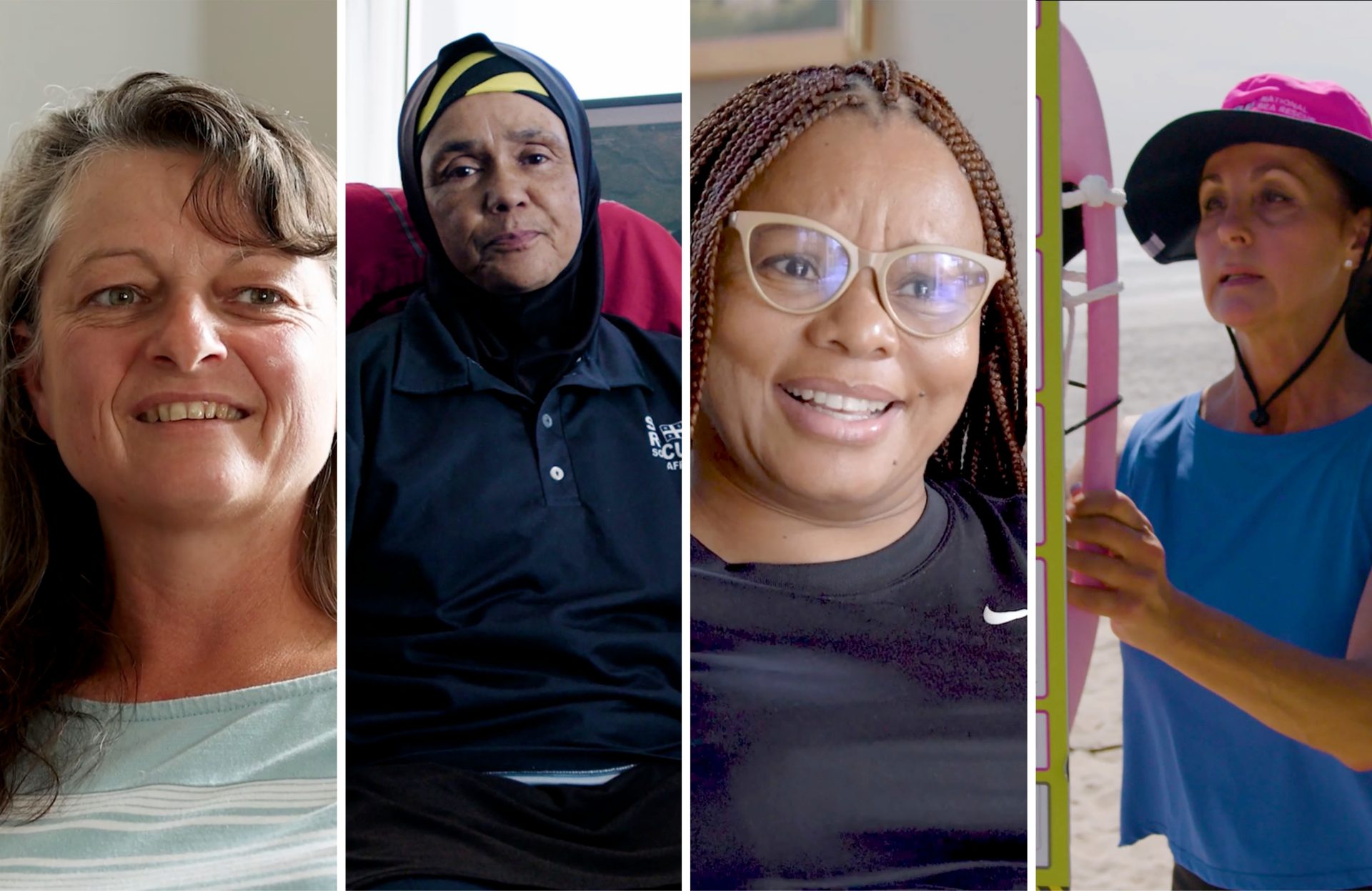
While this story may only highlight four of the NSRI women, this Women’s Day celebrates all the women of the NSRI. They are the heroes who go above and beyond.
South Africa (09 August 2026) – This Women’s Day, the NSRI is celebrating four incredible women, not simply because they are part of an organisation that saves lives, but because of the many different ways they have found to serve their communities.
These volunteers have stories that look very different from one another. Sheryll Grobler is a sea rescue crew member in Gqeberha. Nathi Ndamase teaches children the skills they need to survive unexpected immersion in water. Ilhaam Adams works as a shore controller in Cape Town, helping coordinate rescue missions without necessarily setting foot in the ocean. Theresa Pakulski looks after Pink Rescue Buoys along her local coastline, making sure that a lifesaving resource is ready before an emergency happens.
Their roles are different, but there is a common thread running through all four stories: each woman has found a way to use what she can do to make someone else’s life safer.
For Sheryll, that means being prepared to go out to sea when someone is in trouble.
As a volunteer at NSRI Station 6 in Gqeberha, she trains alongside her fellow crew members so that when the call comes, they are ready to respond. It is work that demands commitment and courage, because the conditions in which people need rescuing are rarely the conditions in which anyone would choose to be at sea.
Yet that is precisely what makes the NSRI’s volunteers so remarkable. They are ordinary people who have made an extraordinary commitment to their communities, knowing that a call for help can come at any hour and in almost any weather.
“The men and women in red wetsuits, on the red and yellow boats, will go out in all weathers, at all times, and rescue you when you’re out of your depth,” Sheryll says.
For Nathi, the opportunity to make a difference begins much earlier than a rescue call.
Related Stories
 They Made It! Young Animal Welfare Volunteers Off to Cape Town
 This Dog Saw Humanity at Its Cruellest – Then Came a Little Girl With R15
As an NSRI Survival Swimming Instructor, she works with children, helping them become comfortable and confident in the water while teaching them skills that could one day save their lives.
It is a role that recognises something important about water safety: sometimes the most powerful rescue is the one that never has to happen.
Nathi knows that fear can be a barrier for children, particularly those who have never felt comfortable in the water. By helping them overcome that fear before an emergency occurs, she is giving them something that could stay with them for the rest of their lives.
“You want to teach them, before anything happens, the comfort of being in the water, and the confidence too, because a lot of people fear water,” she explains.
For Nathi, one of the greatest rewards is watching that fear change.
“When you see someone move from fear of water to confidence in the water, that goes a long way for me.”
And then there is Ilhaam, whose contribution happens from inside the rescue station.
As a shore controller at NSRI Station 16 Strandfontein in Cape Town’s False Bay, she plays an important role in the coordination of rescue operations, helping the wider team turn a difficult situation into an organised response.
There is a lovely honesty in Ilhaam’s admission that she and the ocean “are not very good friends”. She doesn’t need to be a person who loves the sea to be someone who helps protect the people who enter it.
“Even though I don’t enter the water, I can still make a difference from inside the rescue station,” she says.
That understanding speaks to something fundamental about the NSRI. Rescue is never the work of one person. It is a team effort, built on people bringing different skills and experiences to the same mission.
“We are a team of different people, with different skills and different backgrounds, who come together to make the whole mission work,” Ilhaam says.
Her story is perhaps one of the clearest examples of why representation matters. There is no single role that makes someone a rescuer, just as there is no single type of person who can serve their community. What matters is finding where your strengths can make the greatest difference and being willing to step into that space.
For Theresa Pakulski, that space is the coastline itself.
As an NSRI Pink Rescue Buoy custodian for Woodbridge Island and Lagoon Beach in Cape Town’s Table Bay, Theresa helps ensure that the brightly coloured rescue buoys are where they need to be, properly checked and ready to be used when someone finds themselves caught in danger.
Her decision to volunteer came after witnessing two teenage girls being swept out by a rip current at a beach where there was no Pink Rescue Buoy nearby to assist them.
It was the kind of moment that could easily have become a painful memory. Instead, Theresa chose to turn it into action.
Today, she helps make sure that other people have access to a resource that could mean the difference between a frightening situation and a fatal one.
“Anybody from any walk of life, with any experience level, can help make sure those Pink Rescue Buoys are checked, serviced and ready to save a life when they’re needed,” she says.
Her role also highlights one of the NSRI’s greatest strengths: the knowledge held by the volunteers who know their local stretches of coastline intimately.
“It’s really enabled by volunteers who know where the risk spots are on their own patch of coastline. That’s one of the key value-adds of the NSRI: our local knowledge of the South African coastline is huge.”
Taken together, the stories of Sheryll, Nathi, Ilhaam and Theresa offer a much bigger picture of what volunteering can look like.
One goes to the rescue. One teaches people how to be safer in the water. One coordinates the response from shore. One makes sure lifesaving equipment is available before it is needed.
None of their roles is more important than another. Instead, they fit together, creating the kind of collective strength that allows the NSRI to do what it does every day.
Women currently make up 30% of the NSRI’s 1,566 volunteers, while women account for 60% of its 189 employees. Women are also increasingly taking on leadership and operational roles as station commanders, coxswains, rescue crew, rescue swimmers, shore controllers, survival swimming instructors, water safety educators and Pink Rescue Buoy custodians.
Earlier this year, that changing picture was reflected in an especially significant moment when women outnumbered men for the first time on the NSRI’s Maritime Extrication course, one of the organisation’s most physically demanding training programmes. Five of the nine candidates were women, undertaking training that includes rope work at height and the safe extrication of injured casualties from vessels.
For Lizelle Oosthuizen of NSRI Station 17 Hermanus, simply entering the course meant confronting an assumption that physical rescue work was somehow more suited to men.
“It was nerve-wracking to think I was entering this course as a woman, when the stigma is that men are more capable of this,” she said. “This course proved that wrong.”
Her experience matters because every woman who steps into an operational role makes the path a little more visible for the woman who comes next.
That is particularly meaningful on Women’s Day, which commemorates the historic march of more than 20,000 women to the Union Buildings in Pretoria on 9 August 1956, when women stood together in protest against the extension of apartheid pass laws to women.
Seventy years later, the circumstances may be very different, but the spirit of women stepping forward, taking their place and refusing to be limited by expectations remains powerful.
At the NSRI, that spirit can be seen in women climbing onto rescue boats, standing beside swimming pools, coordinating operations from shore and walking their local beaches to make sure lifesaving equipment is ready.
“We pay tribute to extraordinary South African women, especially those who have chosen to serve their communities as NSRI volunteers,” says NSRI Chief Executive Officer Michael Vonk. “They give their time freely, often in demanding environments, responding with courage and skill, day and night.”
Perhaps that is what makes these stories so worth celebrating.
This Women’s Day, the NSRI is celebrating all four women, and the many others like them, who have chosen to answer that call.
How to get involved
Women from all backgrounds are encouraged to volunteer with the NSRI and find their place in the organisation. Whether on a rescue craft, in a swimming pool, in a classroom or behind the scenes, the impact is significant. Visit https://www.nsri.org.za/support-us/join-the-nsri-family to find out how to join.
 by
by