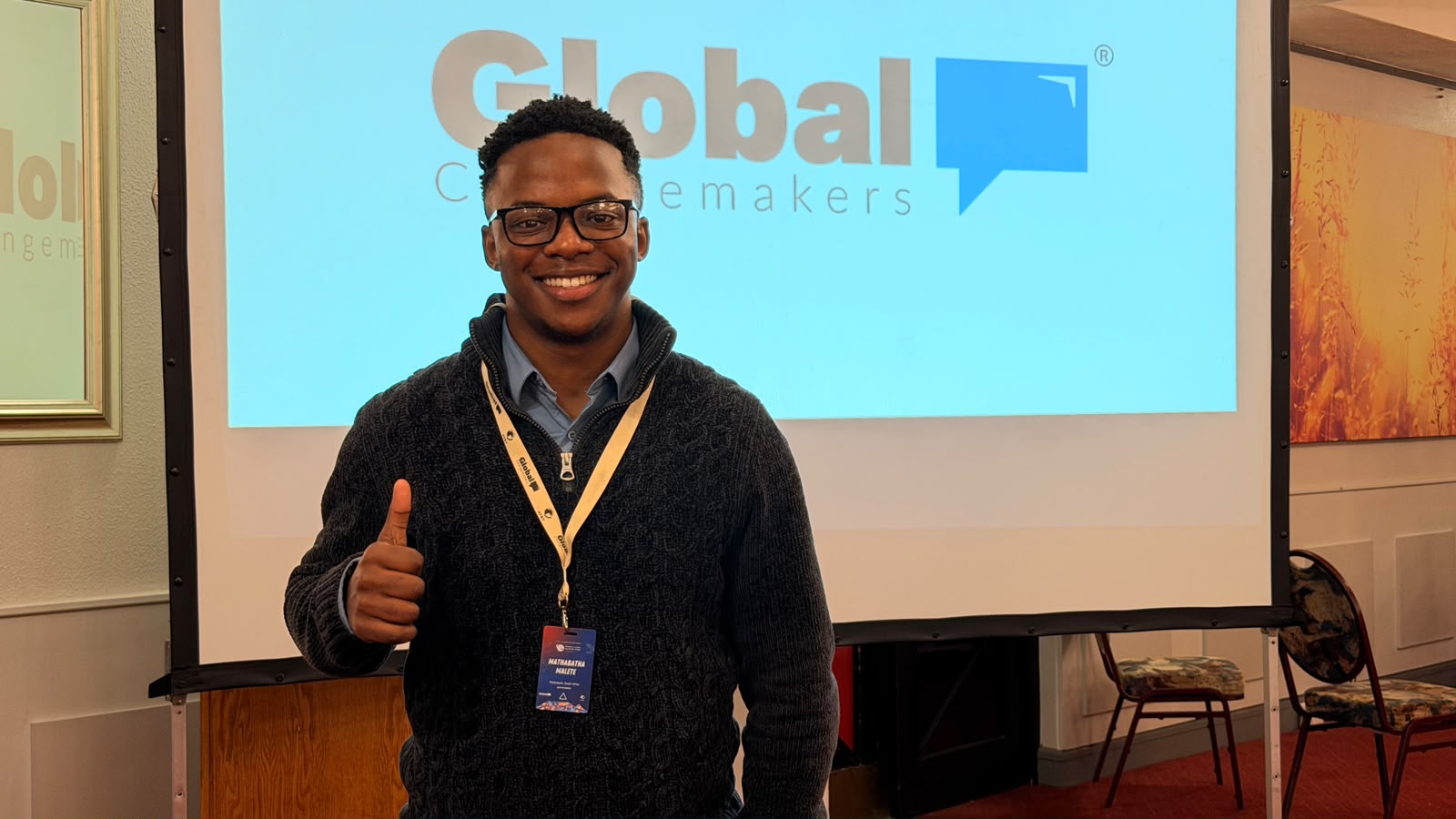
Mathabatha Malete is using his education to open doors for disadvantaged young people who are standing exactly where he once stood. Through Destiny Achieve Foundation, he is helping young people turn their potential into possibility with entrepreneurship education and digital skills.
Cape Town, South Africa (12 November 2026) – Raised in a single-parent household in Johannesburg, Mathabatha Malete saw firsthand how financial pressures and unequal access to opportunities could shape a young person’s future.
When he became a first-generation university student at the University of Cape Town (UCT), that gap became even clearer. He saw how much access to opportunities differed between young people from privileged backgrounds and those growing up in townships and rural communities.
In his first year, he began thinking about the talented, ambitious young people who never get the chance to realise their potential – not because they lack intelligence or determination, but because they lack information, mentorship, digital resources and entrepreneurial education.
That realisation inspired him to establish Destiny Achieve Foundation (DAF), a youth-led nonprofit that helps marginalised young people access entrepreneurship education, digital skills and opportunities for personal growth.
The foundation began with limited resources and a clear purpose: to open doors for young people who are too often overlooked.
Getting it off the ground, he tells us, was far from easy.
“We faced financial constraints, limited resources, and the challenge of building credibility as a youth-led organisation. However, through determination, collaboration, and the support of other passionate young leaders, we began organising educational workshops, engaging schools, and creating opportunities for learners to develop practical skills.”
Since those early days, DAF has grown into an organisation with a developing international network of youth coordinators in South Africa, Botswana, Zimbabwe, the United States and Australia. Mathabatha shares how far its work has reached:
“We have worked with over 50 schools, reached more than 500 learners through our educational initiatives, and developed a broader network of approximately 5,000 young people through our communication and outreach platforms.”
 Son Of Deaf Parents Sayuran Pillay Wins UCT's Top Student Award
 Tshireletso DitIho Takes on Fourth Cycling Challenge for Sanitary Products
For Mathabatha, building the foundation while studying full-time has made the journey especially meaningful.
“It has taught me that creating meaningful change does not necessarily require enormous resources. Sometimes, it begins with identifying a problem, bringing people together, and having the courage to act.”
At the heart of DAF’s work are two pillars: entrepreneurship education and digital inclusion.
Both focus on helping young people in underserved township and rural communities gain the practical skills, knowledge and confidence to take part in the modern economy.
Entrepreneurship Education Workshops
DAF brings entrepreneurship workshops to high school learners, helping them explore what it means to turn an idea into an opportunity.
“These workshops introduce young people to entrepreneurial thinking, problem-solving, innovation, financial awareness, and the process of identifying opportunities within their communities,” shares Mathabatha.
“We encourage learners to understand that entrepreneurship is not simply about starting a business. It is about developing the mindset and skills to identify problems, create solutions, and generate value.”
The foundation has also engaged with schools, including Khulani High School, to introduce learners to skills and opportunities beyond the classroom.
“Our goal is to inspire learners to see themselves not only as future job seekers but also as potential innovators, entrepreneurs, and community leaders.”
View this post on Instagram
Digital Literacy and Technology Education
Alongside entrepreneurship, DAF focuses on digital skills, a growing priority as artificial intelligence and other emerging technologies reshape education and employment.
“We recognise that many young people in underserved communities lack access to computers, reliable internet connectivity, and opportunities to develop essential digital skills.”
Its digital literacy initiatives introduce learners to basic computer skills, online learning resources and digital opportunities, showing them how technology can support their studies and future careers.
“We also aim to help learners understand the growing importance of artificial intelligence and how they can prepare themselves for an increasingly technology-driven world.”
For Mathabatha and his team, the value of this work comes to life in the story of one learner who attended a digital literacy workshop.
The learner had very little experience with a laptop and could not navigate one independently.
They hoped to pursue further education, but even searching for bursaries or completing an online funding application felt out of reach.
“For many young people from underserved communities, this is an overlooked form of inequality. While bursaries, scholarships, and educational opportunities may exist, learners without digital skills can struggle to access them,” says Mathabatha.
During the workshop, the team guided the learner through using a laptop, navigating the internet, finding bursary opportunities and understanding online applications.
By the end, the learner had the skills and confidence to search for funding opportunities and work through the steps of applying for bursaries online.
“What made this experience particularly meaningful was seeing how acquiring a practical digital skill could change a young person’s confidence and sense of possibility. A learner who previously struggled to use a laptop was now better equipped to explore opportunities for their educational future. For us, this represents the real purpose of digital inclusion.”
Youth Leadership, Partnerships and Community Engagement
DAF’s work also extends beyond workshops. The team is building relationships with schools, university communities, youth organisations and other partners to reach more young people.
“Our growing international coordinator network reflects our ambition to connect young changemakers across borders and encourage collaborative approaches to youth empowerment.”
Mathabatha’s own leadership journey has grown alongside the foundation. He has been recognised as a 2026 Global Changemaker, participated in the Global Changemakers Youth Summit and been involved in leadership development communities including the Millennium Fellowship, Aspire Leadership Institute, Awareness 360 and Ripples of Hope.
“I also had the opportunity to participate as a panellist at the United Nations’ Spotlight on the Sustainable Development Goals event in Cape Town, where I contributed to discussions surrounding youth leadership and sustainable development.”
View this post on Instagram
Looking ahead, he hopes to build DAF into a globally recognised, African-led youth development organisation – one that gives young people the entrepreneurial, digital and leadership skills to thrive. His motivation remains deeply personal:
“I want to use my education to open doors for young people who are standing exactly where I once stood, unsure whether any of this is meant for them.”
To bring that vision to life, he wants to reach more township and rural schools, build sustainable partnerships with educational institutions and corporate organisations, and create practical opportunities for young people.
“We are particularly passionate about addressing digital inequality in the age of artificial intelligence. As the world becomes increasingly digital, I believe it is essential that young Africans are not left behind. Our ambition is to ensure that young people from disadvantaged communities are not merely consumers of emerging technologies but are equipped to become innovators, entrepreneurs, and leaders in the digital economy.”
“We also hope to create opportunities for young people to access mentorship, educational resources, scholarships, technology, and networks that can support their personal and professional development,” he shares.
Ultimately, Mathabatha wants DAF to be a place where young people can realise their potential, whatever their socioeconomic background. Because, as he has come to learn, young people do not lack potential. Far too often, they lack access.
To learn more about the foundation or get in touch, visit DAF’s Instagram page.
Sources: Mathabatha Malete
Don’t ever miss the Good Things. Download the Good Things Guy App now on Apple or Google.
Do you have something to add to this story? Please share it in the comments or follow GoodThingsGuy on Facebook and Twitter to keep up to date with good news as it happens, or share your good news with us by clicking here or click the link below to listen to the Good Things Guy Podcast with Brent Lindeque – South Africa’s very own Good Things Guy. He’s on a mission to change what the world pays attention to, and he truly believes there’s good news around us. In the Good Things Guy podcast, you’ll meet these everyday heroes and hear their incredible stories:
Or catch an episode of Good Things with Brent Lindeque or our Weekly Top 5 below. The videos here are always changing, updated with the latest episodes from these two shows. Both are part of Good Things TV, created to bring South Africans balance at a time when the news can feel overwhelmingly negative. Our goal is simple: to remind you that there are still so many good things happening in our country – and to leave you feeling a little more proudly South African.
 by