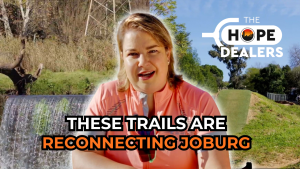
Dr Dulcy Rakumakoe, who, at the age of 6 years old, witnessed the struggle her granny went through in having to make the journey from the village of Tladistad to Temba township in Hammanskraal to collect her hypertension medication – and decided to go on to become a doctor to address this issue facing many people around South Africa.
Johannesburg, South Africa (08 February 2021) – The queue to the doctor’s surgery was long and hot. Dulcy held her granny’s hand as they waited. Once a month the granny would make the journey from the village of Tladistad to Temba township in Hammanskraal to collect her hypertension medication.
“One day, when I was about six years old, my granny said to me, ‘You must become a doctor so I don’t need to stand for such a long time.’ And that was it. From that day on, all I wanted was to study medicine. Throughout school my teachers knew. They even called me doctor – because that’s all I talked about.”
Today Dr Dulcy Rakumakoe runs nine clinics in Gauteng from her head office in Johannesburg – and she has no plans to stand still.
After finishing school, Dulcy got a bursary from the government of Bophuthatswana to study medicine at Wits. She graduated in 1999 and did her internship in Klerksdorp, followed by community service in the village of Ganyesa, near Vryburg in North West Province.
“I did my community service in asmall 60-bed hospital that catered for the residents of more than 20 villages,” she recalls. “It was the reminder I needed of why I went into medicine.”
Dulcy remembers the situation being dire.
“There were no resources. People were not getting enough care. Some people were dying because there was just nothing to save them. Or they would have to be transferred to Klerksdorp, which is over 200 km away.
“The only GPs were local, and most were old. They would drive through the villages in a bakkie and see people on the side of the road.”
After witnessing the deprivation in the region, Dulcy decided not to return to Johannesburg but to open a medical practice, her first, in Vryburg. This was followed soon by a satellite practice in the nearby village of Morokweng.
Related Stories
 They Made It! Young Animal Welfare Volunteers Off to Cape Town
 This Dog Saw Humanity at Its Cruellest – Then Came a Little Girl With R15
“I found myself working seven days a week because there were just so many people who needed care,” she recalls. “In Morokweng I started seeing a lot of mineworkers coming home in December sick with TB, silicosis, HIV and other illnesses. It was as if they were coming home to die.
“I realised then that I could make a big difference in the mining community, so I sold my practice in Vryburg, shut up shop in Morokweng, and bought a practice in the mining town of Carletonville.”
This practice belonged to Dr van Zyl. He had been practising medicine for more than 40 years and was looking to retire.
“But now, Dr van Zyl was an old Afrikaner man,” says Dulcy. “I was concerned that patients would not easily warm up to me. So he and I worked together for a couple of months and, by the time he left, the patients were more than comfortable for me to treat them.”
Dulcy’s work in Carletonville led her to establish an on-site clinic at the Blyvoor Mine, which is situated in the town, after studying occupational health for two years at Wits University.

With the practice in Carletonville and the clinic at the mine, Dulcy’s empire was starting to take shape. She had big dreams, but saw her lack of experience as an obstacle.
“I went into business without proper business knowledge, so I decided to study an MBA.”
She finished her MBA in 2017.
“Part of the MBA is an immersion programme,” she explains.“Students are required to spend time in a world-class business to learn how they do things. So I decided to travel to India because I knew they were big on social entrepreneurship and businesses with impact. I wanted to see how some of these things were being done and learn from the people there.
“I spent my time at the Narayan Eye Hospital, which offers affordable private healthcare, focusing on optical surgeries. I got really inspired there to come home and build a reputable, impactful business that would set the benchmark for affordable healthcare in South Africa.”
After finishing her MBA, Dulcy opened a second practice in Meadowlands and then a third in downtown Johannesburg, under the brand U-Care Medical Centres. In 2019 she was approached by a group of investors and the busines expanded even further, changing its name to Quadcare – which stands for QUality, Accessibility and Dignity.
There are now nine Quadcare clinics in Gauteng, which see between 3 000 and 4 000 patients a month. Dulcy’s ambition is to open another 25 centres in the next three years and boost monthly patient numbers to more than 20 000. She is also looking to grow the occupational health side of the business.
“More and more companies are seeing the benefits of having an on-site clinic for their workforce,” she says.
“The cost per employee is really low and we’re able to manage their primary healthcare needs at their place of work, which means little to no time off to go to the doctor. This is also a great benefit to employees, who get their needs seen to at no cost to themselves.”
Today there are Quadcare clinics in Alexandra, Braamfontein, Carletonville, Edenvale, Evaton, Joburg CBD, Meadowlands, Turffontein and the University of Johannesburg’s Kingsway campus. The clinics operate on a walk-in basis and charge R350 per GP consultation, including medication. Payment can be made in cash or via medical aid.
Dulcy is a big football fan, and has experience as Banyana Banyana’s team doctor. Her love for the game saw her serving as the field medical officer at the FNB Stadium during the 2010 World Cup.
She is also an active member of the LGTBQI+ community and recently won a Feather award as role model of the year. The award sits alongside her Santam Woman of the Future trophy, which is presented to “an entrepreneur whose business is older than 1000 days and who is on her way to creating an empire.”
And if anyone can build an empire, it’s Dulcy.
 by
by