There is no finer sight than a racehorse at top speed. Their long, lithe legs charging along; heads down; bodies almost elevated into the air as they storm past furlong after furlong. It’s a thing of beauty to watch these animals thrive at something that they have been bred, honed and perfected to do for over 250 years. True poetry in motion.
Man has a unique relationship with the horse, and they have been the most versatile and valued animal throughout history. Yet, all too often, this relationship is strained and nowhere in their lifespan could you imagine these elite athletes would end up emaciated and wasting away, at the hand of man.
It was a searing February day in Darling when SPCA inspectors responded to a call by members of the public who had spotted a group of neglected horses. They were met by a stifling, dusty camp with almost no grazing or even shelter, and alarmingly no sign of visible feed.
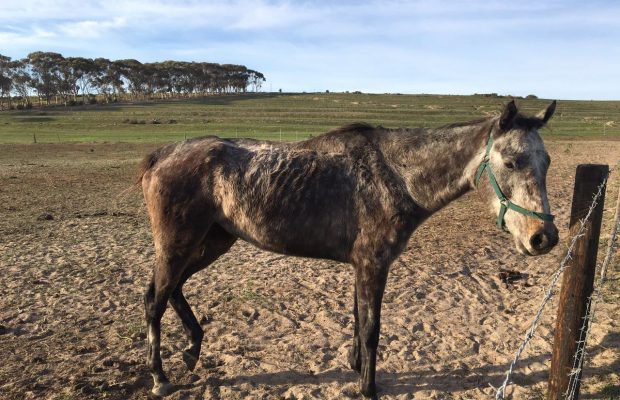
Almost at once they came across Medoca; her incredibly slender frame, wasted muscle and unkempt coat but a mere shadow of her former glory. Could this be the same grey filly whose fiery spirit was recognised by the raceway crowds back in 2014?
An Austere Existence
Medoca was one of four horses left to fend for themselves in this harsh dustbowl. When the team from the SPCA arrived, they were met by a woman who had been charged with the care of the horses by the owner, a former jockey. She proceeded to explain to the SPCA investigators that the Grey mare has been bullied by the Chestnuts and the Bay during feeding time, though it was evident that she was not knowledgeable about equine care.
They advised that Medoca be separated to ensure her survival. The woman followed their instructions and a month later, a follow-up inspection was carried out by the same inspectors who found that the mare appeared to be improving.
Regrettably, but 3 months later in May, the National Horseracing Association(NHA) received notification from members of the community that the Grey mare was once again in the same paddock and her condition had drastically deteriorated. Upon hearing this news, Dr Eugene Reynders, a vet who works with the NHA in the Western Cape, drove without delay to Darling to assess the situation. What he found almost brought him to tears. A mere waif of an animal stood before him; so emaciated that her backbone was sticking out.
He immediately sprung into action and contacted the CEO of the Cape of Good Hope SPCA, Allen Perrins, as well as the local Darling SPCA and instructed that Medoca be removed at once from the property and placed in specialist care with proper feeding and veterinary intervention. Once the owner had agreed to surrender Medoca to the SPCA, she made the journey to the Cape of Good Hope SPCA in Grassy Park, and her long journey toward rehabilitation began.
During this time, Medoca’s breeder became aware of her plight and he offered his support and assisted with feed and her rehabilitation.
This was a horse that had been sold at auction, raced and then further “sold on” since he had bred the Grey; but this did not stand in the way of him coming to Medoca’s aid.
Related Stories
 These Surprising Leopards of South Africa Also Deserve Some Love!
 Dogs Found Safe But Hijacked Vehicle Still Missing – SPCA Still Needs Eyes and Ears!
 Her Former Glory
When a thoroughbred comes into the world there is a silent expectation. A moment of hope that he/she could be the one. And for any breeder or trainer, seeing a horse they reared in such a state, is truly a heart-wrenching ordeal.
Medoca stems from a lineage of well-known racehorses and was foaled in 2011 to Toreador and Bellotto Flash (of the famed Bellotto of Australia); indicative of her superb pedigree. Some may remember her as the magnificent Grey filly in the 2014 season, with the strong and fiery personality.
Toward Stricter Regulations |A Collaborative Industry Approach
While Medoca and her paddock comrades were retired from racing before the implementation of the new NHA Racehorse Retirement Rules, her plight is a stark reminder of the uncertain future Thoroughbreds face in the unregulated world beyond racing.
“Without an adequate system of tracking and monitoring horses after they leave racing, Thoroughbreds will always remain at risk of neglect or abuse,” shares Lyndon Barends, CEO of the National Horseracing Association. “Thankfully, in this case, it was the collaborative effort between the public, the racing industry and the SPCA that resulted in a Thoroughbred’s life being saved. Each one of those individuals who assisted in her rescue is the reason Medoca roams on the beaches of Noordhoek today.”
Adding to this, Dr Reynders shared, “Thoroughbred horseracing is the most regulated and organised disciplines, right from the moment a foal is conceived to when the horse meets its end. But, as with any system, the Thoroughbred industry is only as strong as its weakest link.”
For Dr Reynders and Mr Barends, it is imperative all the industry role players are aware of the welfare issues at stake. From the breeders to the grooms, trainers to the owners, each and every person has a role to play in ensuring the sustainability of the Thoroughbred horse and horseracing as a whole.
Where is Medoca Now?
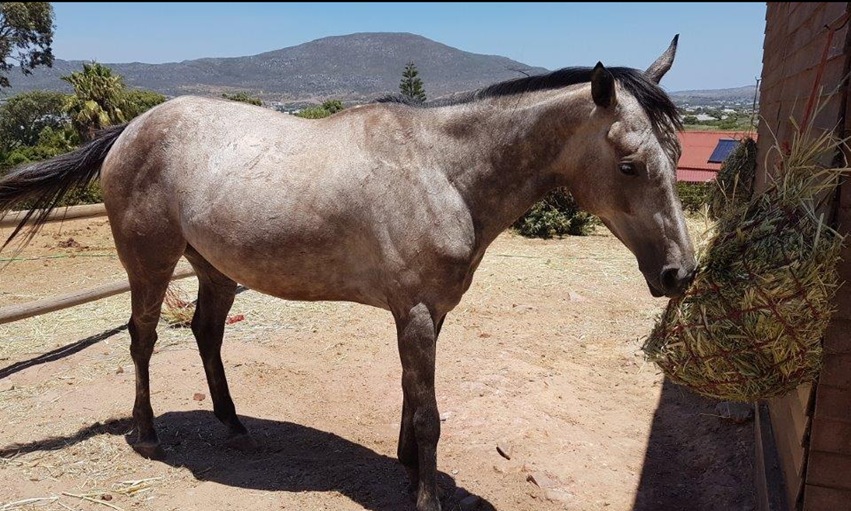
It did not take long for Medoca to thrive in her new home in Grassy Park. She put on weight, and built up a unique bond with the team at the SPCA and learned how to trust humans again. After her rehabilitation, the “Darling Grey” Medoca was rehomed to a loving owner on the lush, green coastline of Noordhoek. Her favourite pastime now? Lazy walks on the beach with her adopted family.
Medoca’s power was not in her blood, her stamina or her racing prowess. It was in her heart and will to survive.
 by
by