While South Africa celebrates Women’s Month, the story of women like Lungi Mkwani, a 27-year-old with brittle bones, highlights the systemic barriers encountered while trying to secure a job and the need to amplify their voices so that they, too, can engage more meaningfully in society.
Johannesburg, South Africa (11 August 2025) – As South Africa celebrates Women’s Month with tributes to powerful trailblazers, entrepreneurs, and leaders, Afrika Tikkun is shining a much-needed light on the one story that continues to be left out. This is the story of South African women living with disability faced with the daunting reality of knocking on doors that remain closed.
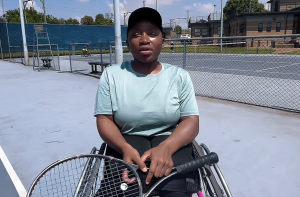
Take 27-year-old Lungi Mkwani from Kagiso near Krugersdorp. Every morning, she wakes up and applies for jobs. Lungi has a qualification in Public Relations (N4) and call centre training, along with experience in business and office administration, but she also lives with Osteogenesis Imperfecta (brittle bones), and that’s where the struggle begins.
“Living with a disability as a woman in South Africa is challenging. Most of our cries are rarely heard,” said Lungi.
Despite volunteering at her local police station from 2022 to 2023, she was turned down for permanent employment.
“They used my disability as an excuse not to employ me. We’re always told, ‘We encourage persons with disabilities to apply,’ but the follow-through never happens,” she said.
“Most people with disabilities are only employed through organisations or short-term learnerships, often with age restrictions. The biggest challenge is that these opportunities only last 12 months and often exclude people older than 28, and not all buildings or facilities are accessible — some have stairs, others don’t accommodate people who are blind or deaf, or those with writing challenges,” Lungi added.
Programme Lead of 360: Disability Inclusion at Afrika Tikkun, Lana Roy, shared that women with disabilities are frequently disregarded due to both their gender and their disability.
“There are few opportunities for advancement, and when they do get jobs, they are rarely given leadership-oriented positions. Access and safety at work are also major issues, particularly when it comes to using public restrooms, transportation, or being taken seriously in settings where men predominate,” she explained.
“Women with disabilities are often more vulnerable to discrimination, exploitation, and even gender based violence, not because of their impairments, but because of how society is structured and responds to their impairments.”
 Collapsing Pit Toilets Replaced at Esikhotho Primary Before Tragedy Struck
 The Sweet Bond That Turned a Stranded Township Kitten’s Life Around
Roy leads Afrika Tikkun’s disability inclusion work, which supports over 1,200 children and youth with various disabilities across South Africa.
“We don’t just support individuals, we work with their families and communities. Our programmes span from early childhood to vocational skills, job placements and advocacy.”
But systemic change is still urgently needed.
Roy says the problem also lies in how policy is applied.
“From a policy side, there needs to be stronger enforcement of inclusive hiring practices, not just compliance on paper. Companies should stop seeing inclusion as a favour and start seeing it as a responsibility, creating spaces where women with disabilities don’t feel like outsiders. And in society, we need to challenge the harmful belief that disability equals incapability, that mindset alone blocks a lot of potential,” she explained.
Giving people living with disability their power and voice back
The voice of people with disabilities themselves is also often missing.
“We often speak about them, not with them. We need to prioritise lived experiences and stop assuming we know what they need. Remember “Nothing for us, without us”. Their voices are often excluded, their needs overlooked, and in many cases, they are seen as either incapable or invisible,” Roy said.
“This leaves them with fewer opportunities and less protection in both formal and informal workspaces. We bring our ecosystem partners together to drive meaningful change in the communities where we work.”
Afrika Tikkun’s disability inclusion team works to ensure that children and youth with disabilities are fully included in the organisation’s cradle-to-career programmes.
A team of administrators, social workers, therapists and nursing staff provide “a myriad of interventions” to help beneficiaries participate and engage more meaningfully.
Young people with disabilities are included in support groups, health and fitness activities, dancing and acting sessions held on Saturdays. After-school offerings include learnerships, work experience, work placements, and specialised training in areas such as hospitality, farming, and vocational skills.
“We run weekly support groups and various events throughout the year, the biggest being the Disability Pageant,” Roy said.
Beyond direct support, Afrika Tikkun plays an active role in advocacy and thought leadership, working closely with the Department of Education and the Gauteng Provincial Government.
Next month, the organisation will host the Valuable 500 Summit, bringing together corporates, government, and civil society to address leadership, representation and reporting of people with disabilities in the workplace.
“It’s about job creation for people with disability, especially young women who are ostracised even more in the workplace as men, as they are seen as vulnerable and too emotional. We need to understand the real issues facing our youth with disability and need to come up with real, practical solutions to try and solve this problem, especially with youth unemployment so high and even higher amongst people with disability.”
Sources: Supplied
Don’t ever miss the Good Things. Download the Good Things Guy App now on Apple or Google.
Do you have something to add to this story? Please share it in the comments or follow GoodThingsGuy on Facebook & Twitter to keep up to date with good news as it happens, or share your good news with us by clicking here or click the link below to listen to the Good Things Guy Podcast with Brent Lindeque – South Africa’s very own Good Things Guy. He’s on a mission to change what the world pays attention to, and he truly believes there’s good news around us. In the Good Things Guy podcast, you’ll meet these everyday heroes & hear their incredible stories:
Or watch an episode of Good Things TV below, a show created to offer South Africans balance in a world with what feels like constant bad news. We’re here to remind you that there are still so many good things happening in South Africa & we’ll leave you feeling a little more proudly South African.
 by
by