South African scientists are being immortalised as superheroes as a way to inspire youth to take an interest in the field of science.
Johannesburg, South Africa – A new set of superheroes, developed in South Africa, is set to inspire youth across the continent to pursue careers in science and technology. With superheroes including Iron Heart, Interferon, The Doctor and The Eradicator, SuperScientists depicts real scientists as superheroes.
Launched last week, SuperScientists are depicted on trading cards, posters, and the web (www.superscientists.org). The scientists share information about their research, give advice to young people to help them succeed, and note who inspires them.
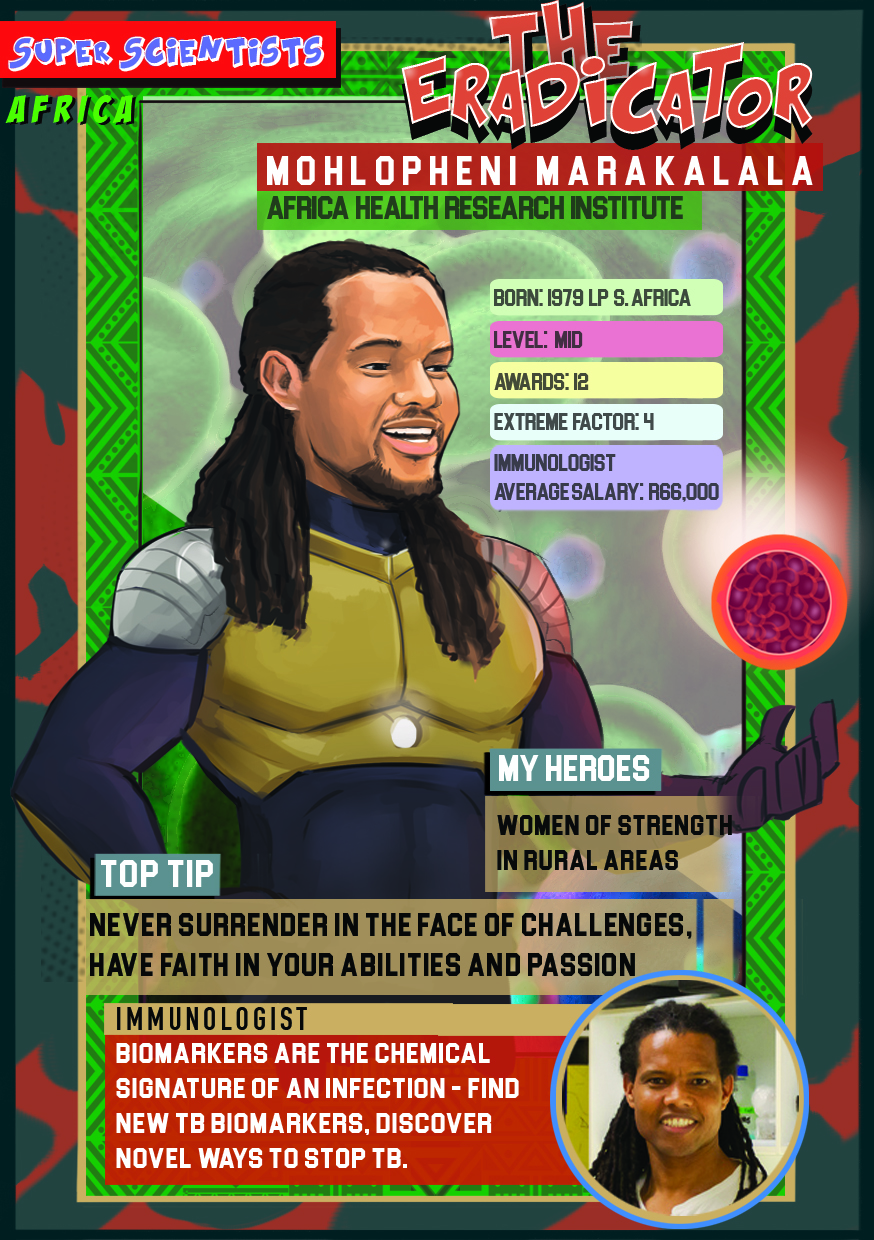
The first four scientists are from the Africa Health Research Institute (AHRI) and the University of KwaZulu-Natal (UKZN) in Durban, South Africa. They include Professor Thumbi Ndung’u (Interferon), Professor Nombulelo Magula (Iron Heart), Dr Emily Wong (The Doctor), and Dr Mohlopheni Jackson Marakalala (The Eradicator).



The idea, from CodeMakers, a non-profit science, technology, engineering, art and maths (STEAM) education organisation, was developed to help young people see themselves in the scientists that are depicted while sharing the how exciting science can be.
“Scientists do amazing things in their daily work to solve the questions of today and create the technologies of tomorrow – they can isolate a single cell from a tumor and read its genetic blueprint, sense when two black holes collided millions of years ago, and fight and win against diseases that have killed millions of people. We want young people to know and name real scientists and better understand how cool science is. Superheroes are a language that young people understand but instead of looking up to a fictional character we want them to be inspired by real people with real superpowers,” says Justin Yarrow, the founder of CodeMakers.
On why he is participating, Mohlopheni says “There are millions of young people with so much potential, we want them to know that they can achieve what we have and more.”
SuperScientist media is intended to work across age ranges. The trading cards are for hands-on play and include information on age, awards, career level, how extreme their research is, and an estimate of the average salary of a scientist in that field.
Young people can use this information in a game to compare scientists or build the strongest team. The web portal provides more detailed information about the scientist’s research and will include interviews that will help older learners and university students identify career options and paths.
The illustrator and designer behind the initial SuperScientists is Curtis Bonhomme (Instagram/Curtis.X). Trained at The Animation School in Johannesburg, Curtis is an up and coming character illustrator and animator.
Related Stories
 SPAR Women’s Challenge Funds Turned Into GBV Prevention Programme
 Street Lines 2026 Showcases the Best of South African Skateboarding
“SuperScientists is important for kids because it allows them to see what a real life scientist is and what they have achieved. It gives children realistic idols and mentors that they can look up to and use as inspiration to see a career for themselves in science and technology when they grow up. It is very important to have real life examples for kids to see what opportunities and avenues are out there especially at a young age,” says Curtis.

 by
by