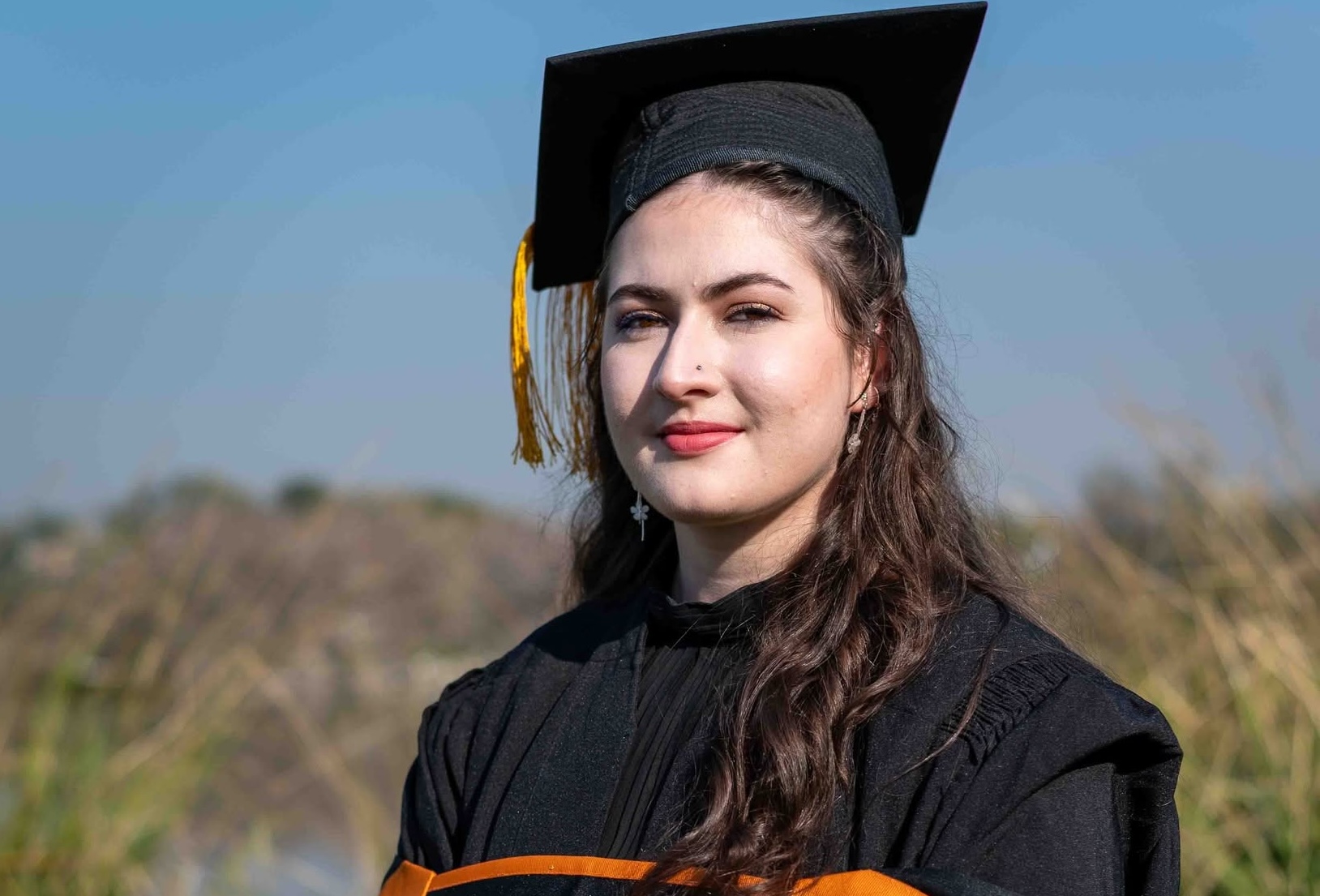
We can all relate to the frustration of a power failure, but what happens when loadshedding threatens the well-being of the elderly? A question, Master’s graduate Gabriella Wysoke set out to answer.
Pretoria, South Africa (09 June 2026) – Many of us dread the inconveniences that come with a power failure. Whether planned or not, they easily ruin plans, alter schedules, and can make the simplest tasks difficult.
It is a struggle we can all relate to, but one Master’s graduate, having worked at a senior residential facility in Pretoria, couldn’t help but investigate the psychosocial impact of loadshedding and power interruptions on older people in South Africa.
University of Pretoria post-grad student Gabriella Beth Wysoke’s passion for both research and practice led her to explore a topic that affects millions of South Africans, yet remains largely overlooked.
“I noticed that during loadshedding, the impact on residents was profound,” she explains regarding her time at the residential facility.
“There was no power backup, so residents had to remain on their floors or in their rooms until the lights came back on.”
These interruptions disrupted daily routines and limited opportunities for social interaction, particularly during shared activities such as mealtimes. The effects became more noticeable as higher stages of loadshedding were implemented.
“When I looked into it, there was very little research on how loadshedding affects older people or how to reduce its impact. I knew I wanted to explore this and contribute something meaningful,” she says.
Gabriella’s findings revealed that the effects of power outages go far beyond inconvenience. For some of the elderly, electricity is essential for medical equipment such as oxygen machines. For many, the impact is psychological.
“Loadshedding can lead to stress, anxiety, loneliness and isolation,” she says.
 SPCA Cyclists Ride for Animals in Need at Wines2Whales
 A Little Kindness, the Perfect Fit: School Shoes Donated in January Finally Find Their Owner
Her research identified key psychosocial effects, including frustration, disruption of routine and increased feelings of isolation. At the same time, she found that many older people demonstrated remarkable resilience.
“They used coping strategies such as acceptance, humour and religion,” she explains.
Through her fieldwork, Gabriella encountered a range of personal stories that shaped her understanding of the issue.
“One woman told me she actually loved loadshedding because it gave her time to read and do her chores during the day,” she says. “It reminded me not to assume what people’s experiences are.”
Another story highlighted a more difficult reality. An older woman shared that the power cuts triggered memories of being punished as a child in an orphanage by being locked in a dark room.
“For her, it was more than just a few hours without electricity. It brought back childhood trauma,” Gabriella says.
These experiences reinforced the complexity of loadshedding and the importance of understanding it from multiple perspectives. Her research also points to broader insights about support systems in South Africa.
“Many participants spoke about the support they received from staff and fellow residents. It showed me the shared humanity that exists and how much our support systems are grounded in ubuntu.”
While South Africa has strong policy frameworks in place, Gabriella believes there’s a need to adapt these to respond to evolving challenges such as loadshedding.
“There were challenging aspects, especially understanding the statistical side,” she says. “But I approached it as an opportunity to grow.”
Reflecting on her research, Gabriella says it has also strengthened her understanding of the role social workers play in supporting people through difficult circumstances.
“It reminded me of how important it is to listen to people’s experiences and to advocate for change,” she says.
She also hopes her work will challenge how society views older people.
“I want people to see older people as active participants in their own lives and in society. Not as people who are removed from the realities we all face.”
 by