Once thought to be remnants of ovens used by early humans, the ancient fossilised nests have been dated between 323,000 and 401,000 years old!
Little Karoo, South Africa (06 November 2026) – Researchers at the University of Cape Town (UCT) have named a group of fossilised underground termite nests, each about 400,000 years old.
They named them after Calitzdorp, the Little Karoo town where the nests were found.
A local artist came across these odd, pipe-shaped structures in the early 2000s. At first, people thought they were the leftovers of ovens used by early humans living in the Little Karoo.
The study revealing the structures as termite nests was published in the Journal of Quaternary Science. It was led by Dr Miengah Abrahams, a senior lecturer in UCT’s Department of Geological Sciences, who worked with colleagues from UCT and other institutions in South Africa, Argentina and Australia.
The new termite trace fossil is called Columnanidus calitzdorpensis. It’s a brand-new ichnogenus and ichnospecies, identified from its distinctive column-shaped structures.
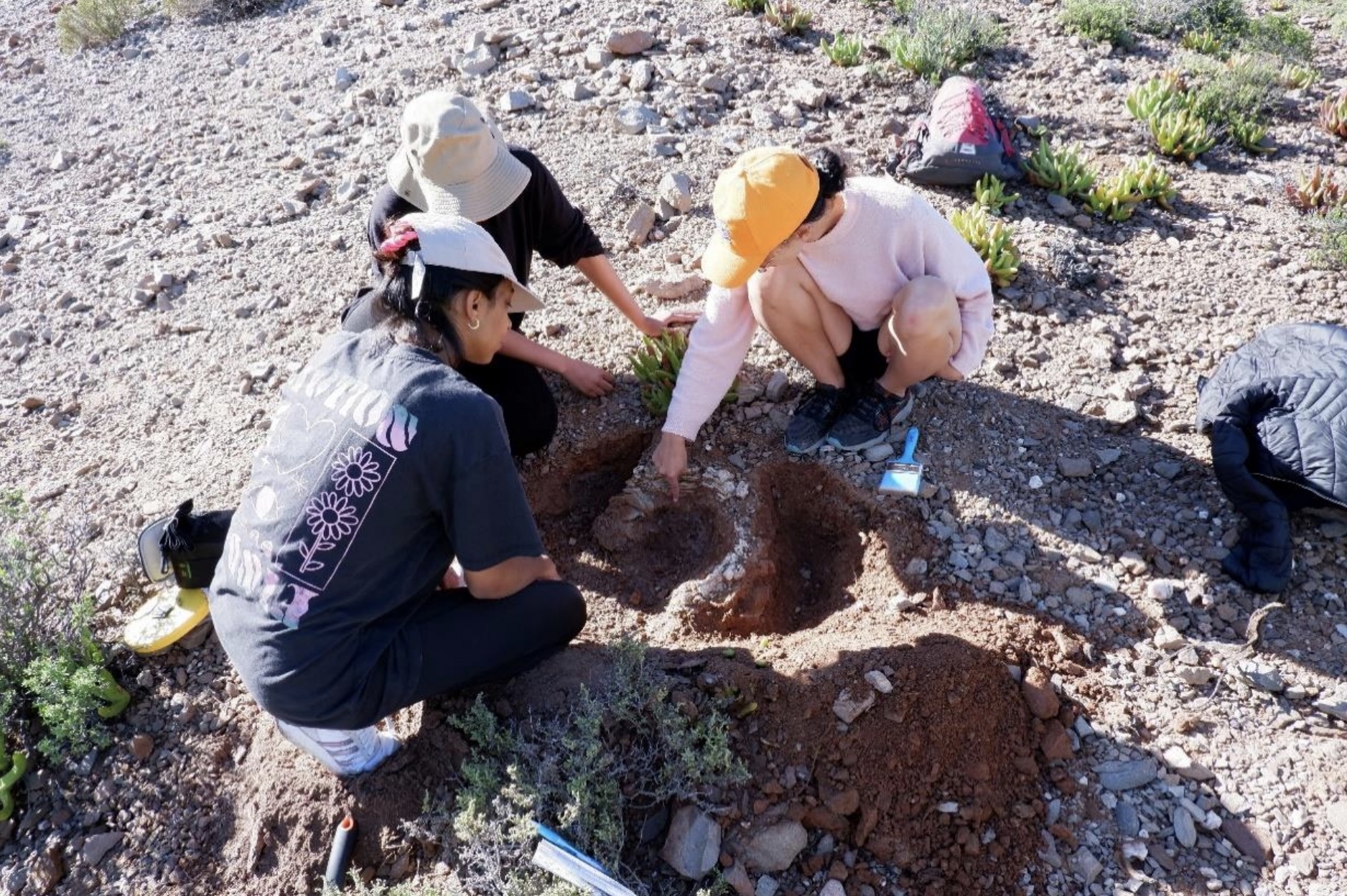
Eight beautifully preserved examples have been found at a single site in Calitzdorp. One of the structures is now kept at the Calitzdorp Museum.
“Ichnology is a branch of palaeontology that studies trace fossils. These offer a unique window into past ecosystems, capturing the behaviours and interactions of ancient life as well as environmental conditions. The words ‘ichnogenus’ and ‘ichnospecies’ refer to the scientific name ichnologists give to the specific type of hardened trace fossil, evidence or remains preserved of a particular organism, such as its burrow, nest or footprint, rather than the body fossil of the organism itself,” Dr Abrahams explained.
The well-preserved nests give us a rare peek into the hidden underground world of an ancient termite species.
The team CT-scanned parts of the structures, using a technique that works like an X-ray. This let them look closely at the burrows and chambers inside.
Related Stories
 Two of the World's 50 Best Burgers Are Made in Cape Town!
 Bringing Life-Saving Water Safety Skills to Richards Bay Schools
Each nest is about one metre deep and 65 cm wide. The hollow space in the middle is surrounded by a thick wall full of tunnels and chambers, showing how these termites were skilled builders.
Uranium-series dating showed that the nests are between 323,000 and 401,000 years old, which puts them in the Middle Pleistocene!
Researchers say that the nests were so well-preserved because the termites’ activity caused minerals, including calcium carbonate, to build up in the sand they used for construction. This process, called ‘calcretisation’, hardened the sand and turned it into fossil, keeping the nests intact long after the soft-bodied insects and other organic material were gone.
The fossils show how ancient termites built their homes, but they also tell us about past ecosystems, landscapes and animal behaviour.
“Trace fossils help us better understand evolutionary changes of ancient animals through time.”
The team plans to look into other fossilised termite and ant nests in the Northern Cape and around Western Cape towns like Ceres and Worcester.
This month, the researchers went back to Calitzdorp to give the local museum a poster about their discovery. They hope it will help local people feel more connected to the amazing fossils in their region.
“Engaging with locals about the fossil heritage on their doorsteps is a rewarding aspect of science. We hope visitors to the museum, especially children, will gain a deeper appreciation for the natural world around them,” said Dr Abrahams.
 by