


If you’ve ever said “Yoh”, “Eish”, “Howzit” or promised to do something “now now”, congratulations… you’re helping shape one of the most fascinating versions of English in the world. New research reveals how South Africans have transformed the language into something uniquely their own.
South Africa (20 June 2026) – Nine out of ten South Africans don’t speak English at home. And yet, listen to a conversation in a taxi, scroll through TikTok, sit in a boardroom, stand in a school playground or join a family braai, and English is everywhere. Not the English you’ll find in a textbook though. Ours is something entirely different. It’s layered with history, flavoured by culture, shaped by community and constantly evolving.
According to new research, South Africans haven’t simply adopted English… we’ve rewritten it.
A new report from The TEFL Academy, titled How South Africa Rewrote Languages, explores how the country’s multilingual identity, urban culture and digital generation are reshaping modern English. The findings paint a fascinating picture of a language that has become far more than a colonial inheritance. Instead, English in South Africa has become one of the most dynamic and culturally expressive varieties of the language in the world.
English dominates business, education, media, meetings and online culture across South Africa, yet only 8.7% of South Africans speak it as a home language. According to the latest census data, isiZulu remains the most spoken home language at 24.4%, followed by isiXhosa at 16.3%, Afrikaans at 10.6% and Sepedi at 10%. English ranks 5th.
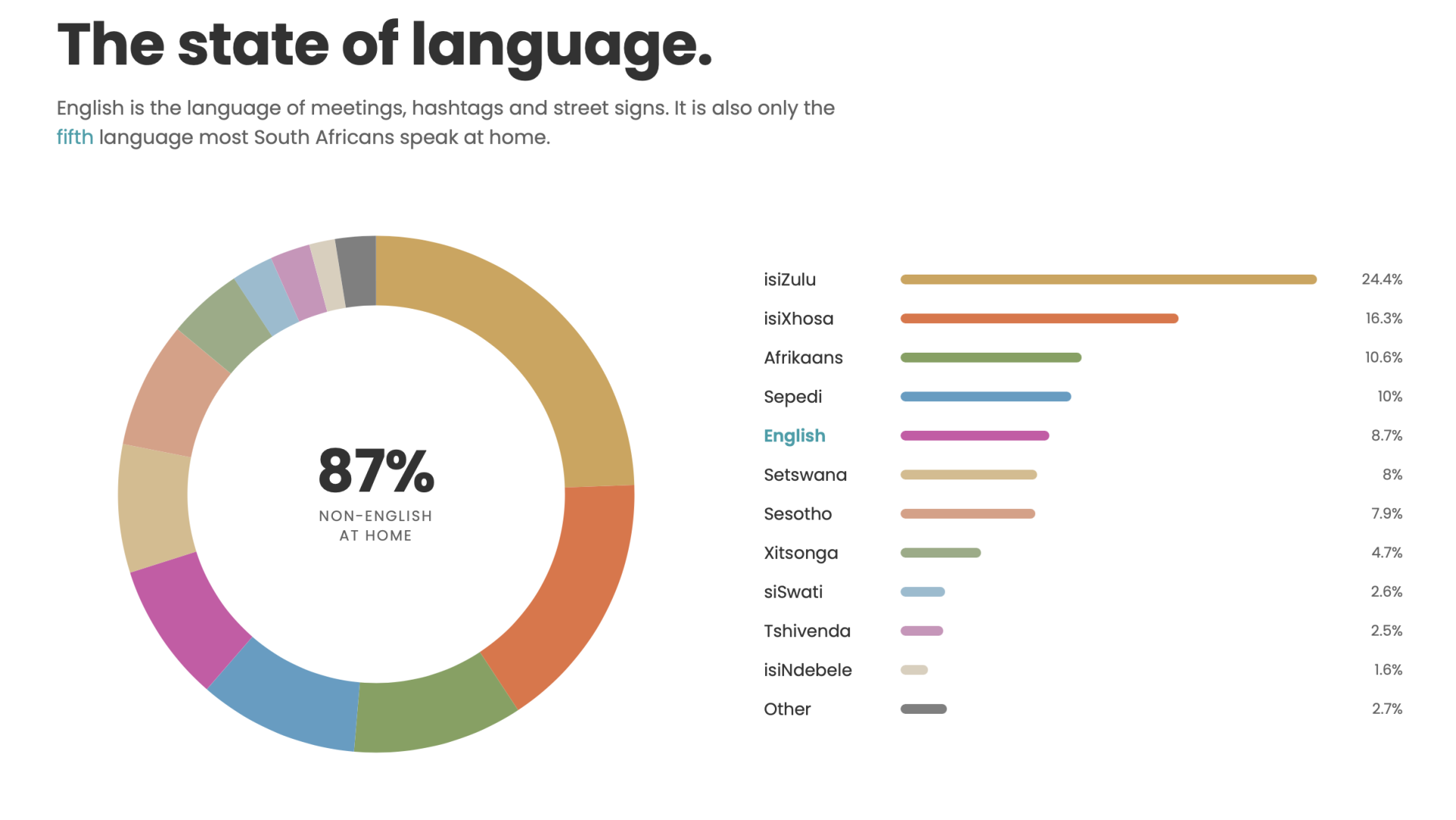
That reality has shaped how the language has evolved here. When people from different language groups needed a common way to communicate, English became the bridge. It connected Zulu and Xhosa speakers, Sotho and Afrikaans speakers, communities arriving in cities from different parts of the country and workers sharing spaces across industries. Over time, that bridge began to change. English absorbed local vocabulary, rhythms, expressions and ways of thinking. It borrowed from indigenous languages, township culture, migration routes, music scenes and everyday conversations. The result is a version of English that sounds unmistakably South African.
Anyone who has ever said, “Yoh, that meeting was hectic kodwa we’ll fix it just now, no stress”, knows exactly what that sounds like.
Far from being “broken English”, researchers say this style of communication reflects something far more sophisticated. It demonstrates linguistic versatility, cultural intelligence and an ability to move effortlessly between different worlds.
Studies from organisations including Statistics South Africa, the University of the Western Cape and the Department of Basic Education show that multilingual communication and code-switching are becoming increasingly common across homes, classrooms, workplaces and digital spaces. Rather than signalling the decline of a language, it points to a generation reshaping communication around identity, belonging, humour and shared cultural experiences.
Rhyan O’Sullivan, Managing Director at The TEFL Academy, believes South Africans possess a communication skill the rest of the world is only beginning to fully appreciate.
Related Stories
 Benoni Community Raised an Army of Sarmies For Children in Need!
 How Do We Keep Matric Dances Special Without Making Them So Expensive?
“South Africans don’t simply speak English, they reshape it in real time. What makes South African communication so remarkable is the ability to move fluidly between languages, tones and cultural references depending on context. In many ways, South Africans have been practising the kind of code-switching the world is only now starting to recognise as a valuable communication skill.”
The roots of this evolution stretch deep into South Africa’s history. Language has long been tied to identity, opportunity and resistance. From the impact of the Bantu Education Act to the Soweto Uprising and the democratic recognition of multiple official languages after 1994, language has never been just about words in South Africa.
But the report points out that many of the real architects of modern South African English were never academics or policymakers.
“The most generative writers of South African English never sat in a textbook committee. They were on taxi ranks in Soweto, in studios in Soshanguve, in playgrounds in Khayelitsha.”
That influence is perhaps most visible in the phrases many South Africans use every day without a second thought. Words and expressions like “Howzit”, “Aweh”, “Lekker”, “Sharp Sharp”, “Yoh”, “Eish”, “Ayoba”, “Shem” and “Mzansi” have become part of a shared national vocabulary. They carry meaning, emotion and context that often can’t be translated directly.
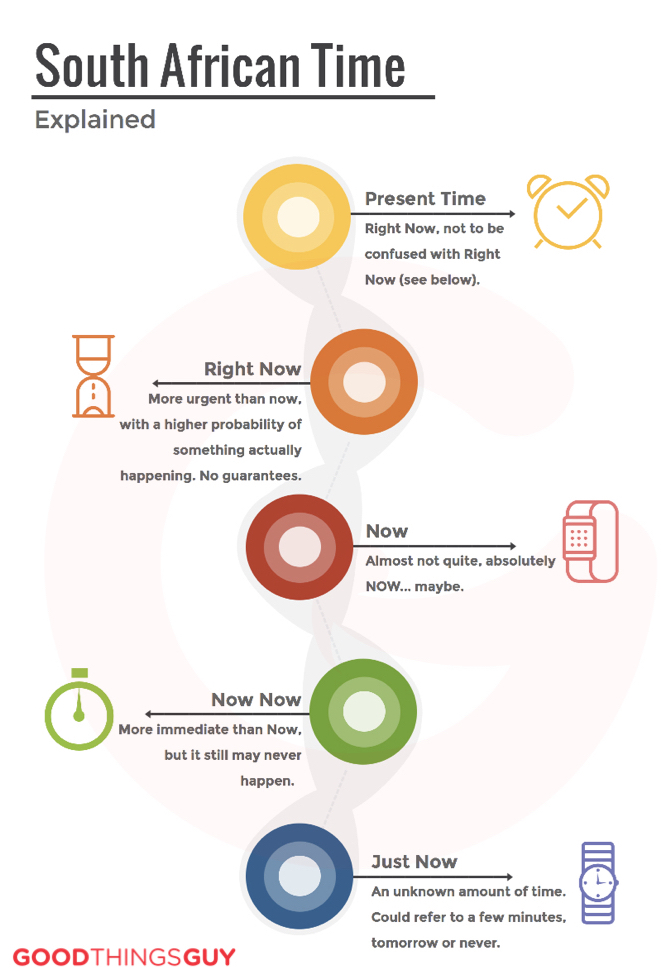
And then there are those uniquely South African concepts that leave visitors scratching their heads. “Now now” doesn’t necessarily mean now. “Just now” definitely doesn’t mean immediately. Yet every South African somehow understands exactly what is being communicated.
Township slang systems like Tsotsitaal, alongside the rise of Kwaito and Amapiano culture, have accelerated these language blends across generations. Digital platforms have taken them even further. Amapiano content surpassed 11.4 billion TikTok views in 2025 and now charts in more than 70 countries worldwide. Along with the music, South African expressions are finding new audiences through memes, creators and online communities.
Gen Z may be driving the latest wave of linguistic creativity, but the report makes it clear they didn’t invent it. They inherited one of the most multilingual societies on Earth and brought it into the digital age.
South African TEFL instructor and alumni member René Janse van Rensburg says adaptability remains one of the country’s greatest strengths in communication.
“South Africans naturally move between different ways of speaking depending on the environment they’re in. The best way I can describe it is like pairing a formal dinner jacket with jeans, you understand both worlds and know when each works. That’s what modern fluency looks like today. It’s not about choosing between formal or informal English, it’s about understanding context, culture and communication.”
She adds, “We often underestimate how advanced code-switching actually is. Moving between English, Afrikaans, isiZulu or township slang in a single conversation requires cultural awareness, emotional intelligence and adaptability. Those are skills many international students still struggle to develop.”
While many countries worry about preserving languages or protecting them from outside influence, South Africa has shown that languages don’t have to compete to survive. They can collaborate, borrow from one another… and grow together.
English may have arrived here through history but what it has become belongs to South Africans. It carries the sounds of our streets, the humour of our communities, the rhythm of our music and the spirit of a nation that has always found ways to connect across differences.
And if that isn’t ayoba, what is?
 by
by 










Yes. The article is interesting, but I think its central claim — “South Africans have rewritten English into something entirely their own” — needs to be challenged quite strongly.
The really interesting question is: how is South African English fundamentally different from what happens to English everywhere it is used by multilingual communities?
1. The article presents a universal feature of language as if it were uniquely South African
The most obvious weakness is the suggestion that South Africa is doing something exceptional simply because English has absorbed local languages, cultures and ways of speaking.
But this is precisely what languages do.
English has never been a fixed system. It has continually absorbed vocabulary, pronunciation, grammar and expressions from other languages and cultures. Modern English itself is the product of centuries of contact between Anglo-Saxon, Norse, Norman French, Latin, Greek and many other languages.
And this process is still happening:
* Indian English has absorbed vocabulary and discourse patterns from Hindi and other Indian languages.
* Singapore English has developed distinctive vocabulary, grammar and discourse patterns through contact with Malay, Chinese languages and Tamil.
* Nigerian English reflects contact with numerous Nigerian languages.
* Jamaican English developed through contact between English, West African languages and Creoles.
* Irish English has distinctive structures influenced by Irish.
* American English has incorporated enormous amounts of vocabulary from Indigenous languages, Spanish, French and other languages.
* Australian English has its own vocabulary and expressions, including borrowings from Aboriginal languages.
So “English absorbs the languages around it” isn’t evidence of something uniquely South African. It is evidence of how English works.
The more interesting question would therefore be:
What specifically distinguishes South African English from other contact varieties of English?
The article doesn’t really answer that.
⸻
2. “Rewriting English” is rather sensationalist
The title makes it sound as though South Africans have taken an existing language and created something fundamentally new.
But language evolution is normally incremental, collective and unconscious.
People don’t generally decide:
“We’re going to rewrite English.”
They communicate with the linguistic resources available to them. If a word from isiZulu is more expressive, useful or culturally meaningful than an English equivalent, they use it. If a particular expression becomes understood by a community, it spreads.
Eventually, some of these innovations become established features of a variety of English.
That’s happening everywhere.
The article would be much stronger if it said:
South African English demonstrates particularly clearly how languages evolve through sustained multilingual contact.
That’s a much more defensible and linguistically interesting claim.
⸻
3. The article also ignores the uncomfortable side of linguistic evolution: outsiders can be excluded
This is perhaps the biggest issue with the article.
It celebrates expressions such as:
“Yoh”
“Eish”
“Howzit”
“now now”
“just now”
“lekker”
“sharp sharp”
as evidence of cultural richness.
And they certainly can be.
But language is simultaneously a mechanism of inclusion and exclusion.
If you understand “I’ll see you just now” culturally, you are part of the linguistic community.
If you don’t, you’re left wondering:
Does that mean five minutes, this afternoon, tomorrow, or never?
The same thing happens in virtually every linguistic community.
A British person might say:
“I’ll pop round later.”
A learner may interpret pop literally.
Or:
“I’ll give you a ring.”
Someone learning English may wonder why ring means telephone.
Or:
“That’s a bit awkward.”
Depending on context, that might mean anything from slightly inconvenient to absolutely disastrous.
Or consider British workplace expressions:
“Let’s take this offline.”
“I’ll pick this up.”
“We need to touch base.”
“That’s not really my cup of tea.”
These aren’t necessarily difficult because of grammar. They’re difficult because they belong to a linguistic culture.
South African English isn’t unusual in this respect. It is simply a particularly rich example.
⸻
4. “Code-switching is a valuable communication skill” needs qualification
The article repeatedly celebrates code-switching, and rightly so.
But there’s a danger in turning it into a kind of fashionable superpower.
A multilingual speaker switching between English, Afrikaans and isiZulu isn’t necessarily demonstrating something fundamentally different from what happens when a Londoner switches between formal workplace English and London slang.
Nor is code-switching necessarily evidence of “emotional intelligence”.
Sometimes people code-switch because:
* one language has a better word;
* the other language is more efficient;
* the speaker is addressing a particular audience;
* the expression has cultural meaning;
* everyone present shares the language;
* or simply because that’s how people normally talk.
The article arguably psychologises ordinary multilingual behaviour by attaching labels such as “cultural intelligence”, “emotional intelligence” and “adaptability”.
⸻
5. The really important point for English learners
There is an even bigger issue here that the article almost completely misses.
Whose English is the learner supposed to learn?
This is particularly important for non-native speakers.
Imagine an international student learns:
“now now” = later, but fairly soon.
Then they go to Britain and use it.
Or they learn:
“Howzit?”
Then use it in a formal business meeting in London.
Or they learn a particular South African pronunciation, idiom or discourse pattern and assume it is international English.
They may be perfectly competent in South African English but still encounter difficulties elsewhere.
And the reverse is equally true.
A South African learner may learn British or American English in a textbook and then discover that the English spoken around them doesn’t behave like the textbook.
This raises an important distinction between:
English as a language
and
English as a collection of socially situated varieties.
There isn’t one single English anymore — if there ever was.
⸻
6. “Correct English” becomes a much more complicated concept
The article is right to challenge the idea that these forms are simply “broken English”.
But it risks replacing one simplistic idea with another.
We shouldn’t say:
“This is broken English.”
But we also shouldn’t automatically say:
“Everything is equally valid everywhere.”
Language is context-dependent.
For example:
“Sharp sharp, I’ll sort it out now now.”
might be perfectly natural among friends.
But it might be inappropriate in a formal international presentation.
Likewise:
“Yo mate, that’s bloody brilliant!”
is perfectly understandable British English, but I wouldn’t necessarily recommend it to a Japanese executive presenting to an American investment committee.
So language proficiency isn’t simply knowing more words and grammar.
It includes knowing:
Which language, which variety, which expression, with which people, in which context.
That’s a much more interesting definition of fluency.
⸻
7. The article’s biggest irony
There’s actually an irony running through the whole article.
It celebrates South Africa because:
“languages don’t have to compete to survive. They can collaborate, borrow from one another… and grow together.”
That’s probably the strongest idea in the entire article.
But then the title frames this as:
“How South Africa Turned English Into Something Entirely Its Own.”
Those two ideas don’t quite fit.
If English is constantly being reshaped through contact with other languages, then South Africa hasn’t uniquely “turned English into its own”.
Rather, South Africa is another fascinating example of a process that is happening globally.
And perhaps that’s the more powerful conclusion:
South African English isn’t remarkable because it breaks the rules of linguistic evolution. It is remarkable because it demonstrates those rules so vividly.
⸻
8. And languages never stay still
This, to me, should be at the centre of the critique.
The article talks about “modern South African English” as though we’ve arrived at something.
But today’s South African English is simply one point on a moving timeline.
Twenty years from now:
* some slang will disappear;
* some expressions will become mainstream;
* new words will appear;
* pronunciation will change;
* social media will introduce new expressions;
* younger speakers will alter existing meanings;
* English will borrow from other languages;
* and some things currently considered “incorrect” may become completely normal.
That’s what languages do.
The English of Shakespeare wasn’t the English of Chaucer.
The English of Chaucer wasn’t Old English.
And the English spoken in Britain today isn’t the English of 1900.
There is no final version of English.
⸻
A stronger thesis
If I were turning this into a discussion for an advanced English lesson, I’d replace the article’s thesis with:
South Africa has not uniquely transformed English; rather, it provides a particularly striking example of a universal linguistic process: when languages come into sustained contact, they borrow from one another, develop new identities and create new varieties.
And then I’d introduce the genuinely difficult question:
If English belongs to everyone who speaks it, who gets to decide what “good English” is?
That leads to much richer questions:
1. Is there such a thing as “correct English”?
2. Should an international English learner aim for British or American English?
3. Should local varieties be taught alongside standard varieties?
4. When does a new expression become part of the language?
5. Can a language be both global and culturally local?
6. Does using local slang demonstrate fluency — or can it create barriers for outsiders?
7. Is language change something we should celebrate or control?
8. If English is constantly changing, what does it actually mean to be “fluent”?
And that last question is probably the most interesting one for your teaching context:
A highly proficient non-native speaker may know more grammar and vocabulary than a native speaker, but still struggle because they don’t know the invisible cultural rules governing how English is actually used.
That’s where this article could become much more than a piece about South African slang: it could become a discussion about whether “native-speaker English” is even an appropriate model for global English anymore.