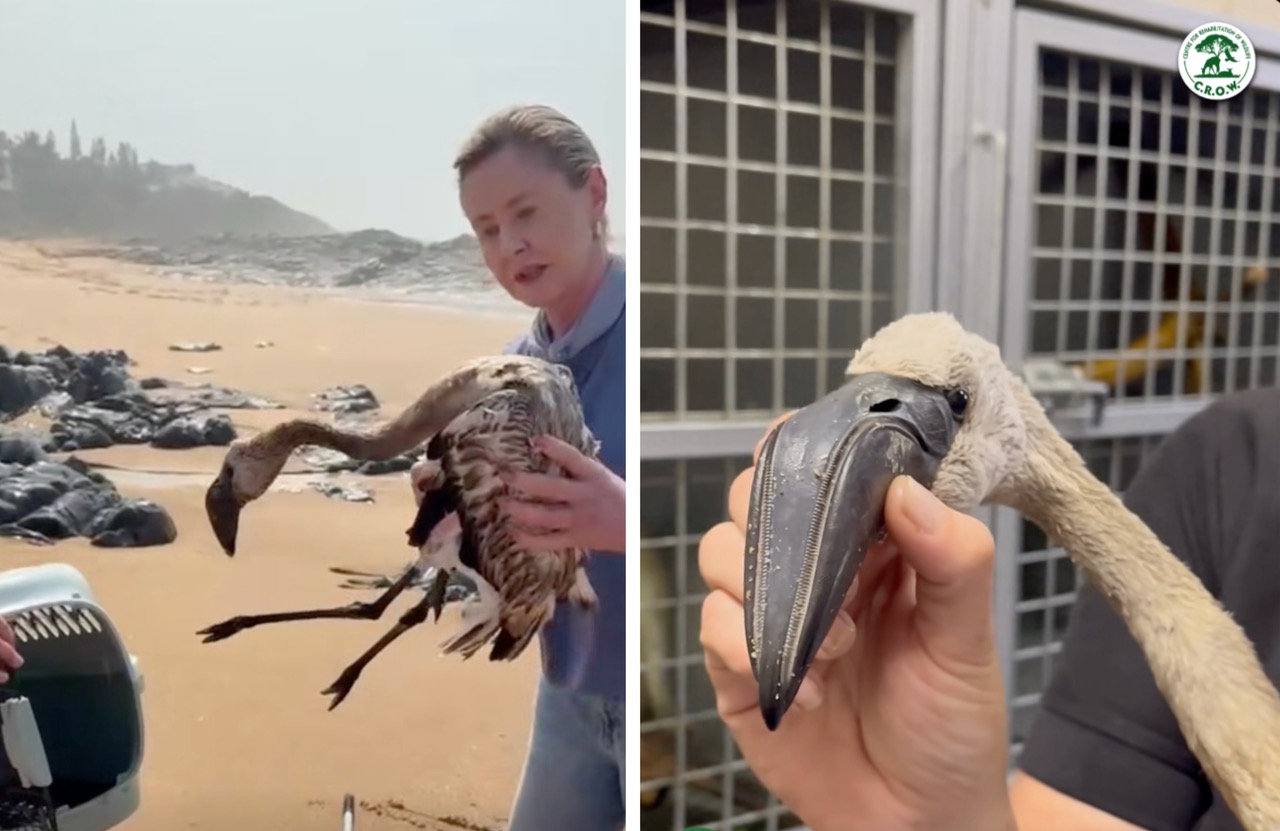
What was a flamingo doing on the beach in the first place? Its rescuers don’t quite know, but thanks to a team effort, the long-legged patient is now recovering and will soon return to its pink self!
Ballito, South Africa (14 September 2026) – Wildlife Rescue responded to a rather unusual call-out from a beach-going Bianca recently. ‘Help! There’s a flamingo on the beach!’
Flamingos aren’t generally found on beaches. They usually park off in shallow, alkaline or saline inland wetlands, lagoons, and salt pans. So, finding one ‘on the deep end’ was quite the mystery to Wildlife Rescue, who assist distressed animals in the residential areas and estates of Ballito and surrounds.
Upon arrival, the team found the little juvenile bird struggling against the waves and water.
“Definitely not something we see every day!” the non-profit shared. “Thankfully, it appeared uninjured and just a little lost and very far from where we’d expect to find it!”
The team acts as first responders and works in collaboration with other wildlife organisations and vets to ensure rescues receive expert care.
Once captured, the flamingo was transferred to the Centre for Rehabilitation of Wildlife (CROW) in Durban, where it could be assessed and properly cared for.
“We don’t often get the opportunity to care for a juvenile Flamingo, making this little patient a rare visitor to CROW.” the team shared.
CROW’s rare visitor received a thorough health check, fluids for rehydration, and treatment for fleas and mites. He also got to show off his new pink feathers and cool beak!
Related Stories
 Volunteers Flown Into Boosmansbos Hack Over 5300 Pines Before Fire Season
 Give Hudson a Chance! SA Maker Turns Recycled Plastic Into Furniture
The juvenile will recover at the rehabilitation centre until it’s time for release back into the wild…this time into an area better suited to its flamingo ways!
“We are so grateful to be able to play a part in this beautiful Flamingo’s journey to recovery.” shared CROW.
“We may never know what journey brought this youngster to our coastline, but thankfully someone noticed and called for help.” shared Wildlife Rescue.
Wildlife Rescue also shared a few interesting facts about flamingos:
• Their pink colour develops from pigments in the food they eat.
• Juveniles are much greyer and paler than adults.
• They often feed with their heads upside down!
• They can sleep standing on one leg.
• And despite those long, elegant legs, they are powerful flyers capable of travelling considerable distances!
 by