


International Mountain Day was implemented to create awareness about how important mountains are for the population of the world. This is why…
International Mountain Day isn’t a silly, meaningless day. It has real purpose and shares an important message. The United Nations decided to create the day to build awareness.
Did you know:
- Mountains cover around 22 percent of the earth’s land surface and are home to 13 percent of the world’s population.
- They provide sustenance and well-being for 915 million people, but also indirectly benefit billions more living downstream.
- Ninety percent of the world’s mountain dwellers live in developing countries, where a vast majority live below the poverty line and 1 out of 3 faces the threat of food insecurity.
- Mountains provide 60-80 percent of the world’s freshwater – without which sustainable development that aims to eliminate poverty and hunger would not be possible.
- Mountains have a key role to play in providing renewable energy, especially through hydropower, solar power, wind power and biogas.
We thought we would honour some of South Africa’s majestic mountains with pictures and facts about them. We know that Table Mountain is the most popular one in SA but did you know we have many more with equally great qualities? Here are some of the mountains we found in SA that you might enjoy reading about.
Table Mountain – Western Cape
Did you know that Table Mountain is the second shortest mountain is SA? It comes in at 1084 metres. The reason it is so popular is that it has a unique shape. The distance from one end of the tabletop to the other is approximately 3 km’s and forms part of the Table Mountain National Park.
The Mountain is home to many of South Africa’s indigenous fauna and flora. Table Mountain is at the northern end of a sandstone mountain range that forms the spine of the Cape Peninsula that terminates approximately 50 km to the south at the Cape of Good Hope and Cape Point.

Ghaamsberg – Northern Cape
Ghaamsberg Mountain is just 33 km’s from the Namibian border and shouldn’t be confused with the Gamsberg Mountain which is in Namibia.
The mountain is noted for its biological diversity. It has “unique ecologies on the various inselbergs, peaks, hills and plains in the vicinity, having varied rocky and shallow soil substrates, support a wide diversity of plants, animals, birds and insects, including rare and endemic species, a number of them threatened.”
Sadly we couldn’t find a picture of this mountain, so if you have one and would like to feature it here, pop us an email.
Compassberg – Eastern Cape
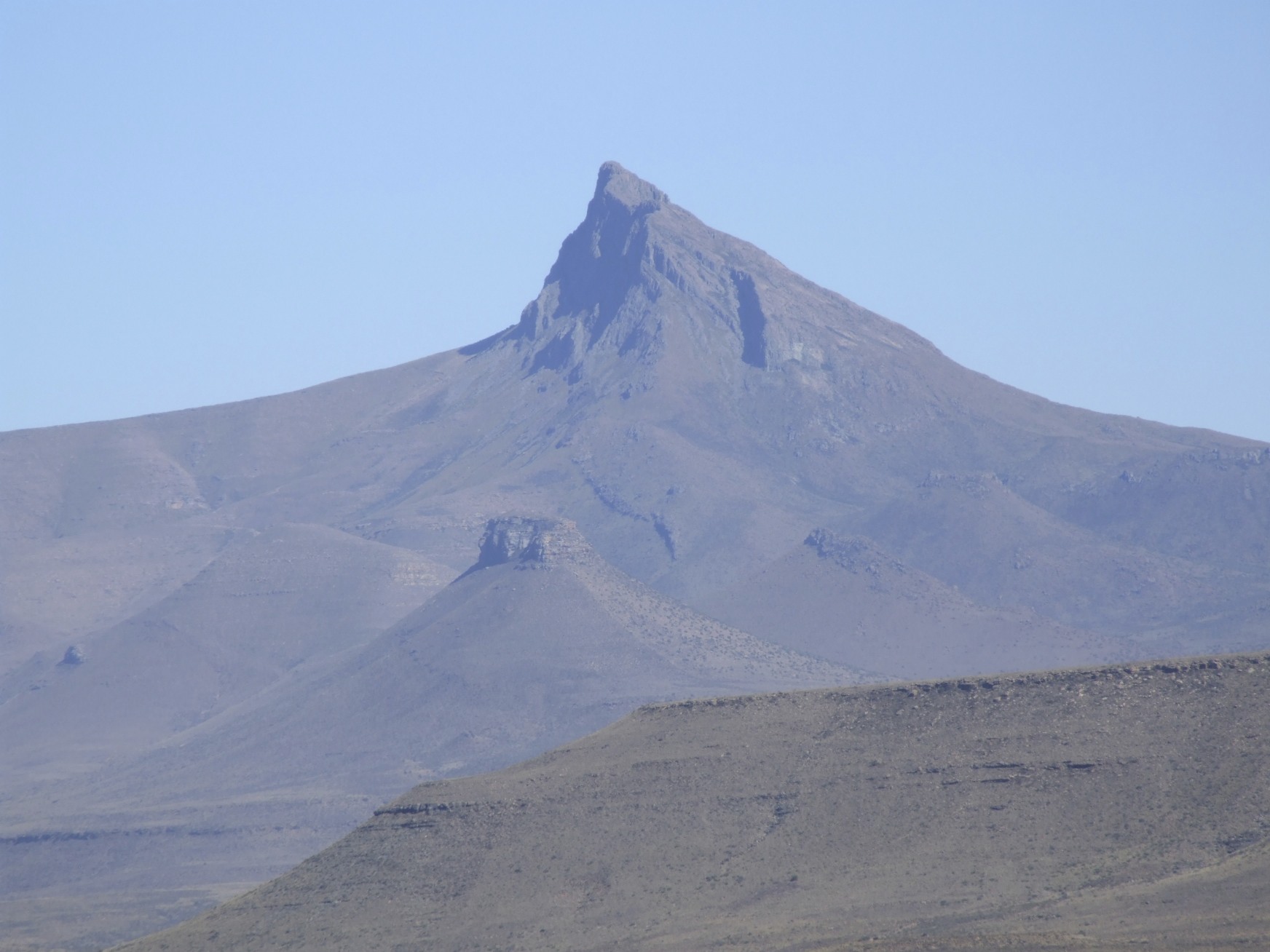
Compassberg is a mountain peak of the Sneeuberge range in South Africa. It is located 55 km due north of Graaff-Reinet in the Eastern Cape Province. At 2504 metres, it is the highest peak in South Africa outside the Stormberg-Drakensberg massif.
It is said the mountain resembles a compass needle. The mountain harbours a diversity of species, including endemics. High on the list of important species is a butterfly, the Compassberg skolly (Thestor compassbergae), found only the slopes of this one mountain, and nowhere else.
The hiking trail has become one of the most popular in the area.
Mafadi Peak – The Drakensberg Range – KwaZulu-Natal
The Drakensberg Range spreads through multiple provinces within South Africa. It features predominantly in the KwaZulu-Natal as well as in the Eastern Cape and Free State.
The Mafadi is the highest mountain in South Africa, it is located in the KZN and is part of the Drakensberg Range. Its peak is on the border of South Africa and Lesotho.
The name of the mountain is currently under dispute. Mafadi (which literally means the Mother of Fadi) could possibly be changed to its original Sotho name Ntheledi (which means “Makes me slip”, referring to the nearby stream). The Sotho name is considered, by some, to be more relevant and correct.

These are just a few of the many mountains that are scattered across the country. Which mountain have you travelled to that you loved? Share your recommendations in the comment section
You can watch a video from the UN sharing facts about International Mountain Day below.
 by
by 