


Kyle Smith is on the hunt for one of South Africa’s most mysterious little mammals, and you could be the one to help him crack the case.

Pretoria, South Africa (21 August 2025) – The chances are slim, but have you ever spotted a slinky black-and-white creature darting through the veld late at night? You might have come across an African striped weasel. Or maybe you didn’t even notice it, because hardly anyone ever does.
That’s exactly why University of Pretoria PhD candidate Kyle Smith is reaching out for help with. He’s on a mission to learn more about the African striped weasel, one of our country’s most elusive little carnivores, and he’s hoping ordinary South Africans can help him piece together its story.
It looks a bit like a tiny skunk with an attitude, with a ‘slinky, snakelike way of moving,’ Kyle says. They’re nocturnal, tend to keep to themselves, and when threatened, can spray a stink that sticks around for weeks.
“Fortunately, I haven’t yet experienced that,” says Kyle.
So, not your average neighbourhood guest.
His fascination started back in varsity when he realised there was a South African mammal he’d never seen. Something he says was almost unthinkable.
“I couldn’t believe that there was indeed a South African mammal that had eluded me,” he admits.
For context, Kyle is a nature geek. The 31-year-old from Benoni grew up in a family of nature lovers. He has already spotted about 518 South African bird species, which says a lot.

He’s been hooked ever since, even managing a rare sighting of two weasels along a dirt road in the Sandveld. Most sightings, though, are by pure chance, and actual research on these little guys is almost non-existent.
That’s where the public comes in. Kyle is calling for anyone (farmers, hikers, night drivers, nature lovers) who might have spotted an African striped weasel (alive or as roadkill, sadly), to get in touch with details.
If you know of burrows, resting spots, or even have blurry cellphone photos, he wants it all.
“In particular, I’d appreciate comments from people who have seen them in arid, desert-like areas, or who might know the location of some of the animals’ burrows or resting places,” he says. “If I can collect scat, I could find out much more about the animal’s diet too.”
It’s important not to confuse them with striped polecats or honey badgers, though (see infographic below).
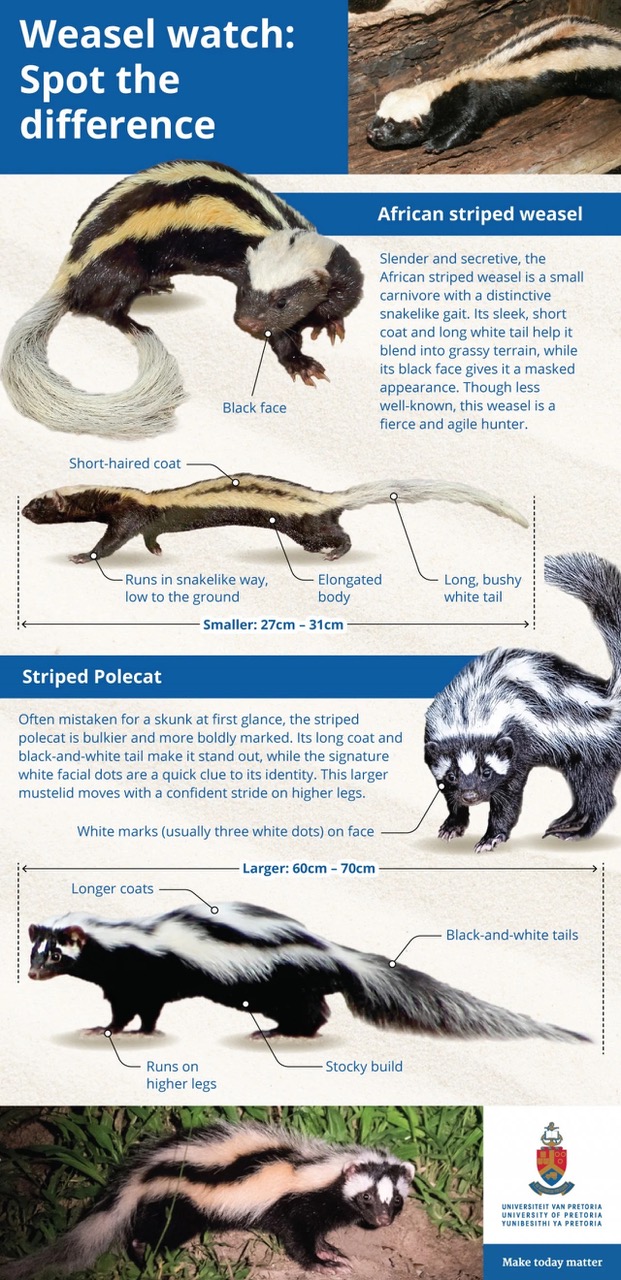
Hardly anyone knows where these little guys live, how many there really are, or if they’re even endangered. They might be out there in decent numbers, or they could disappear before most South Africans even know they exist.
Kyle’s work, supervised by a team of small carnivore experts, hopes to finally collar and track wild weasels, figure out what they eat, and put these secretive creatures on the map.
Recent sightings have come from the Western, Northern and Eastern Cape, as well as the KwaZulu-Natal Midlands but Kyle’s eager for news from anywhere in southern Africa, especially dry, desert-like areas.
If you think you’ve seen an African striped weasel (look for that distinctive black-and-white colouring), you can drop Kyle an email at africanstripedweasel@gmail.com.
Let him know the date and place, add photos if you can, and share any other details you noticed (like what the weasel was up to, or if you saw a burrow nearby).
Most of us will never cross paths with one of these little ‘ghosts of the veld,’ but thanks to Kyle’s mission and a bit of public teamwork we might finally get to know one of South Africa’s ‘most unknown residents’.
 by
by 