Postgraduate engineering students from Stellenbosch University have just earned international recognition for building technology that can detect rare whale calls hidden deep within years of Antarctic datasets.
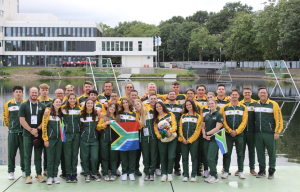
Stellenbosch, South Africa (19 February 2026) – Christiaan Geldenhuys, a PhD candidate, and Master’s student Günther Tonitz from Stellenbosch University’s Department of Electrical & Electronic Engineering earned second place overall at BioDCASE 2025.
The competition forms part of the prestigious IEEE Detection and Classification of Acoustic Scenes and Events (DCASE) Challenge – one of the world’s leading benchmarks in audio machine learning.
In simple terms, the duo built smart computer models that can detect whale calls hidden inside years Antarctic recordings. The specific task this year focused on Antarctic blue and fin whales. Both species were hunted to near-extinction during the industrial whaling era and are still being carefully monitored as their populations recover.
Scientists use underwater microphones to track their calls, but the ocean is loud. Waves, ice movement, ships and other marine life all add to the background noise. Plus, whale calls only made up about 5% of the recordings, Stellenbosch Univeristy shares.
Christiaan and Günther had to design algorithms capable of spotting faint, rare signals buried in complex, multi-year datasets with very low signal-to-noise ratios. Competing against six international research teams, the Stellenbosch duo achieved the second-best technical performance overall!
At the BioDCASE workshop in Barcelona, their peer-reviewed paper received the Jury Award for Best Paper. The duo later expanded their research, winning another Best Paper Award at the Southern Africa Telecommunication Networks and Applications Conference (SATNAC) 2025.
“These achievements highlight the strength of advanced signal processing and machine learning research within the Faculty of Engineering, and underscore Stellenbosch University’s growing international impact in audio machine learning and environmental monitoring,” writes Stellenbosch University’s Amber Viviers. “Congratulations to Christiaan, Günther and Prof Niesler on this exceptional accomplishment.”
Sources: Linked above.
Don’t ever miss the Good Things. Download the Good Things Guy App now on Apple or Google.
Do you have something to add to this story? Please share it in the comments or follow GoodThingsGuy on Facebook and Twitter to keep up to date with good news as it happens, or share your good news with us by clicking here or click the link below to listen to the Good Things Guy Podcast with Brent Lindeque – South Africa’s very own Good Things Guy. He’s on a mission to change what the world pays attention to, and he truly believes there’s good news around us. In the Good Things Guy podcast, you’ll meet these everyday heroes and hear their incredible stories:
Or catch an episode of Good Things with Brent Lindeque or our Weekly Top 5 below. The videos here are always changing, updated with the latest episodes from these two shows. Both are part of Good Things TV, created to bring South Africans balance at a time when the news can feel overwhelmingly negative. Our goal is simple: to remind you that there are still so many good things happening in our country – and to leave you feeling a little more proudly South African.
Related Stories
 Rescue Rhino Lula Welcomes Her First Calf After Two Years of Freedom!
 The Hope Dealers: Jozi Trails Looks After the City's Longest Green Artery
 by
by