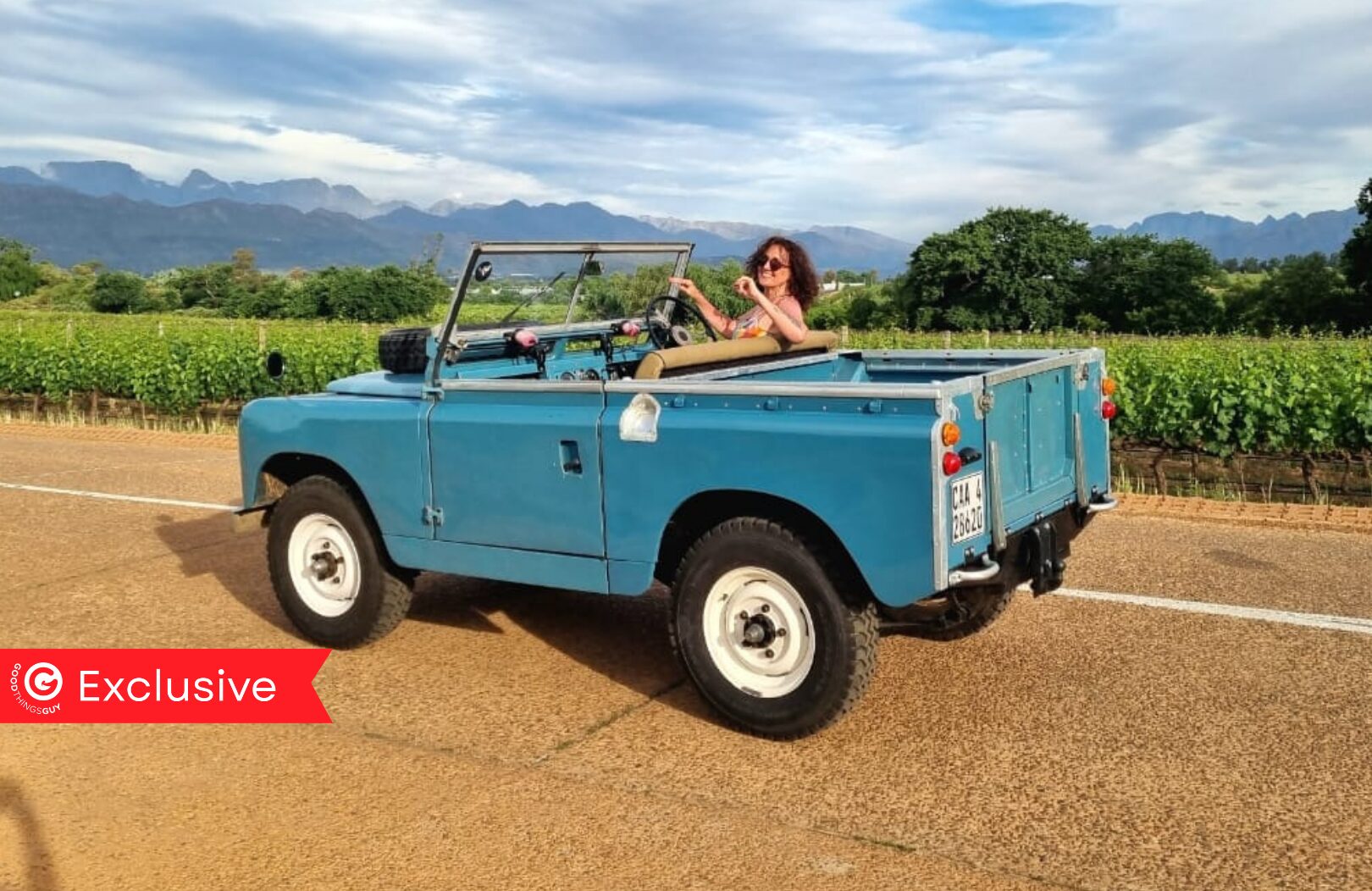
Michelle Geere has turned a 1959 Series 2 Land Rover into more than just a restoration project; she has learned life lessons, taken leaps of faith and found purpose along the way.
Western Cape, South Africa (04 December 2025) – Michelle Geere, like many in South Africa, used the lockdown to start up a new hobby. But instead of feeding sourdough or getting her hands dirty in the garden, she restored a Land Rover. And not just any Land Rover, a 1959 Land Rover Series 2.
For those not in the know, a Series 2 is heritage on wheels (so are the Series 1s and 3s, but today is about the 2s). It’s the kind of car you do not encounter every day; it’s basically a Land Rover before technology got in the way. The Series 2 was launched in 1958, making Michelle’s new hobby pretty classic!
Today, the Series 2 is anything but fast or quiet, but what it lacks in modern finesse it makes up for in quirk and in history. These cars were tools used in farming, global travel and even military operations. They were useful because they could get the job done.
As a card-carrying member of the Land Rover Owners Club, when Michelle’s story landed in our inbox, I just had to interview her. Land Rovers of all specs are having a moment with younger generations. Seeing these beauties being lovingly plucked out of the past and restored makes my heart feel full. Anyway, before I get carried away, let’s get back to Michelle and her Series 2.
So, Michelle found her first Land Rover through a farmer who had used it as a hunting vehicle. It was even painted in camo, but she saw right past it all and was totally smitten. So she made the purchase and sent the car to her family mechanic, filled with hope and excitement over what this car could become and then reality set in.
“When he sent through the list of parts he needed, I started getting concerned. The list was… long. Then I had her shipped down to a mechanic in Somerset West for a closer look, and that’s when I was absolutely freaked out. The body was raised on spacers – not properly, just spacers. The exhaust system? Created with plumbing pipe. Actual plumbing pipe. And the seats were nothing but wire frames.
I remember standing there thinking: “What did I just do? What have I gotten myself into?”
But as any Land Rover owner will tell you, the challenge is part of the fun! Now came the time to source the parts, some of which were pretty hard to find and start the restoration.
Related Stories
 SPAR Women’s Challenge Funds Turned Into GBV Prevention Programme
 Street Lines 2026 Showcases the Best of South African Skateboarding
“At the start, I didn’t even know what a distributor was or what a handbrake looked like. She had a Toyota diesel engine when I bought her, and initially, I wasn’t thinking about restoration at all – I wanted to experiment with biodiesel because I’m conscious of the planet.
Those yellow biodiesel cans became iconic in Vredehoek, where I was living. Every month, I’d collect my diesel in these bright yellow containers from Stikland. Because biodiesel is made from used chip and KFC oil, you could literally smell my arrival from blocks away. I drove her around for a year in that hand-painted camo, reeking of fast food, and I absolutely loved it.
But then I started learning about the original 2.25 petrol engine, and everything changed.”
Michelle found herself a mentor in Stefan Coertze from Land Rover Worx, who started by showing her how things worked, but also encouraged her to get her hands dirty. Stefan had Michelle take the engine apart with her own hands. Every Sunday, the duo would tinker on the Landy so she could learn all the ins and outs.


“Finding parts became an obsession. I haunted scrap shops, and at one of them I bought two entire Land Rovers – one had the right era engine for my vehicle. Stefan encouraged me to rebuild it myself, guiding me through every bolt and gasket.
I even flew to London and went to Landy scrap sales, hunting for parts for Beastie (yes, that’s what I call her).”
Funny enough, Michelle has one part she is still on the hunt for, so if you know someone with a set of original windscreen wiper motors for a 1959 Series 2, reach out!
There were many moments when Michelle sat back and thought, “What have I done?” and even one where her partner was quite concerned, too. She regales how her partner, without a car and needing to get to her corporate job, got a massive shock when she borrowed a doorless, camo-painted, fast-food fuelled Beastie. Needless to say, Michelle’s partner didn’t love the situation.
“That moment of absolute panic taught me something important: not everyone shares your vision when the project is still a work in progress. Sometimes you just have to have faith that the beautiful thing you see in your mind will eventually exist in reality.”


The project for Michelle became more than just something to do during the lockdown. It helped guide her towards a new path in her career as well. She left her advertising job, started a tech startup and forged a way forward.
“Obviously, I had doubts. Massive doubts. Who was I to think I could build a technology company from scratch?
But then I’d look at Beastie, sitting in the garage in pieces, and something clicked.
If I can build an engine, I can build a business. If I can rebuild a carburetor, I can build a tech product. Every bolt I turned, every part I sourced, every Sunday I spent covered in grease at Stefan’s workshop – it was all teaching me the same lesson: you don’t need to know everything at the start. You just need to be willing to learn, to ask for help, and to keep going when it gets hard.
Building Beastie was a two-year journey that laid the foundation for everything I have today. She taught me that I’m capable of far more than I ever imagined. That restoration project gave me the confidence to take the leap into entrepreneurship.”
With her hobby and her career doing well, Michelle shifted her focus to something far more meaningful, and this is perhaps my favourite part of this story. Through restoring Land Rovers, Michelle has been able to help her sister, too.
Michelle and her sister Estelle have lost their parents, first their mother during a house robbery when Michelle was only 28 and later, their father. Before her father’s passing, he took care of Estelle, who was born with Down syndrome, but once he passed, Michelle became responsible for Estelle’s financial well-being and care.
“When my dad died, the responsibility of looking after my sister Estelle passed to me. There wasn’t stashed cash waiting. There was no trust fund. I had to make a plan.
I asked my mom’s family to please contribute to Estelle’s living expenses for a period of 4-5 years while I invested every cent I could into her account.”
Estelle and her husband live in a wonderful care home, and with the help of family and Michelle, they make ends meet.
“About two years ago, I thought, ‘Wait a minute. ‘ If I sell Beastie, I can put all those funds into her account and create as much financial independence as I can for her future.”

It became part of Michelle’s passion. Restoring Beastie was more than just a fun project; it became a project for purpose.
“That realisation transformed everything. Every part I sourced, every hour Stefan and I spent restoring her to era-correct specifications – it all meant something more. Beastie wasn’t just a Land Rover anymore. She was security. She was me doing everything I could to make sure Estelle and her husband have the independence and dignity they deserve.
And now, every Land Rover I restore carries that same mission forward.”
Beastie will serve her purpose, and every Land Rover to come will have that same empowerment factor built in. Like how one cooks with love and the food tastes better, so too does a Land Rover built with purpose look and feel better!
“When I do stop and reflect, I realise it’s a magical privilege to have a passion that can help generate independence for Estelle and her husband.
It was my late mom’s dream that Estelle lived an independent life. It’s the reason she allowed her to marry Frans in the first place – she believed in their right to build a life together, to have dignity and autonomy.”
“Being able to contribute to a dream she created – a dream she didn’t get to see fully realised – is the most special thing in the world to me.”

For Michelle, the restorations bring so much joy. Having worked hard to get to this point, we asked what advice she has for others who are curious about a project but may feel intimidated to pick up the first tool.
“We feel overwhelmed because we’re scared. We’re scared we’ll break things. We’re worried about injuries without even being in the game yet.
Just start with one small thing. Loosen a bolt. Look on YouTube for how to replace a starter motor and try it. If it doesn’t work, you can try again or take it to a mechanic. You haven’t lost anything except a bit of time and maybe some pride.”
“I didn’t know what a distributor was five years ago. I didn’t know how an engine worked. I was terrified I’d ruin everything. But I started anyway – one bolt at a time, one Sunday afternoon at a time.”
For Michelle, her success has come from the repetitive.
“Just keep going back every Sunday and work on the thing you’re fixing. Even if there’s no progress for months – even if you’re staring at the same broken carburetor, the same rusted chassis, the same impossible problem week after week – just keep showing up.
One day you’ll look up, and there she is: Beastie. Beautiful, running, complete.”
So while Michelle’s story may have made you start reading for the cars, it’s likely left you feeling so much more. Come for the cars and stay for the heart. If you are interested in what Michelle is working on next, or you know where she can find those wiper motors, be sure to reach out!
This interview is part of a series I am working on, in which South African women highlight fun and fearless pursuits that bring them joy, raise awareness, and sometimes even change perceptions. You can read more here.
 by
by