


The internet doesn’t need more noise. It needs more truth. And truth still starts with someone brave enough to tell a story that actually happened.
South Africa (12 November 2025) – Last week, I posted a rant on my socials. An important one. One that I’m sharing again here… not because I love a moan but because it matters.
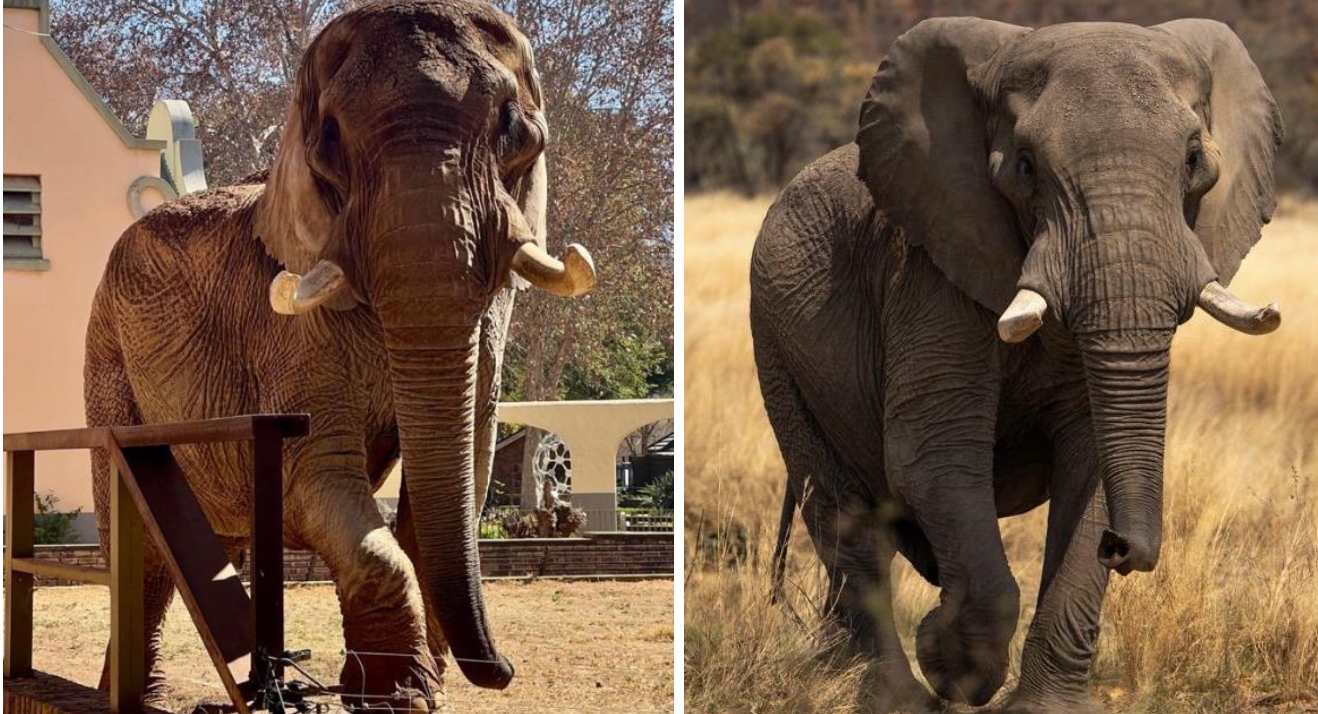
It started with a photo that went viral. An elephant named Duma (once known as Charlie/Charley) had finally been freed after more than forty years in captivity. It was a beautiful story. But the version shared by a massive international page, with 350,000 followers on Facebook and 2.3 million on Instagram, was wrong.
Completely wrong.
Their post was misleading, their “news” missed the point, and with it, the soul of something sacred.
We’ve followed Duma’s journey for years. His story is one of patience, heartbreak, and hope, from being torn from his family at the age of two to finding freedom again through the incredible work of the EMS Foundation and their Towards Freedom programme. Duma is not just surviving. He’s thriving.

The Five Big Misses
1. The photo was fake.
The image wasn’t Duma at all. It was 100% AI-generated. It showed an elephant that didn’t exist, standing in a setting that never happened. The real photos of Duma, how he has recovered and how he is living “his best life” are far more moving. Those moments carry truth. And that truth deserves to be seen.
2. The timeline was false.
The post suggested that Duma had just been freed, when in fact, he’s been living in freedom for over a year now. The EMS Foundation’s Towards Freedom programme worked tirelessly to relocate him from Pretoria Zoo to a private reserve in Limpopo. Since then, his healing has been remarkable. He’s thriving, growing stronger and learning what it means to be wild again.
3. The geography was wrong.
He wasn’t South Africa’s “last zoo elephant”, as the post claimed. He was Pretoria’s last. There are still three elephants at Johannesburg Zoo, Lammie, Mopani and Ramadiba, who remain in captivity. The EMS Foundation continues to fight through the courts for their release.
4. The comments missed the point.
Because of the misleading post, people flooded the comments with negativity.
Related Story
“He’ll never survive”, “How is he supposed to find a herd?”, “He’s doomed.”
None of that is true. He is surviving. And he is doing really well. Duma has adapted beautifully. He forages, explores and interacts naturally. His caretakers have documented how his body language, once filled with stress and trauma, now shows calm curiosity.
5. They missed the meaning of his name.
And honestly, to me, that’s everything.
When the EMS Foundation took him in, they didn’t just give him space, they gave him identity. They renamed him Duma, which means Thunder in isiZulu.
And thunder always follows silence.
It’s nature’s way of saying, I’m still here.
That’s what Duma represents. After years of silence, confinement, and exploitation, his spirit roared back to life. He’s no longer “Charlie”, the lonely zoo attraction. He’s Duma. Wild, uncontained and alive.
Thunder doesn’t ask permission to be heard. It simply rolls across the sky, reminding you that power and presence don’t fade… they just wait for their moment.
The Rise of AI “Slop”
Since posting my rant, my feed has exploded with more of these so-called “feel-good” posts. You’ve probably seen them too. Although it seems that most don’t realise that the images are AI, or don’t pick up the long emotional paragraphs, and the same formula: heartbreak, hope, hashtags, repeat.
The comments on these posts are very telling.
Just yesterday, a post appeared from a random Facebook page (this page had no connection to the David Sheldrick Wildlife Trust) of two baby elephants tucked into beds beside humans, wrapped in blankets with lanterns glowing beside them. The caption read like a script:
“When the night fell over the Nairobi Nursery, the air was filled with heartbreaking cries. Several baby elephants — recently rescued after losing their mothers to poaching — couldn’t stop calling out into the darkness… But they weren’t alone. The devoted caretakers from the David Sheldrick Wildlife Trust stayed by their side all night…”
Beautiful words. Heart-tugging imagery. But all fake.

The image was completely AI-generated and the story was partially made up. A half-truth.
The David Sheldrick Wildlife Trust does rescue orphaned elephants. Their keepers do care for them tenderly. But they don’t tuck them into human beds. They don’t light lanterns or cuddle them like some bushveld bedtime story. The goal of these organisations is to rewild elephants, to help them return to their natural state. Not to humanise them for social media engagement.
These AI posts simplify complex conservation work and distort truth into fairy-tale versions of reality. And worse, they make money doing it.
How They Profit Off You
Here’s how it works: social media rewards engagement. The more a post is liked, shared, or commented on, the more the algorithm boosts it. Pages that rack up enough followers and views can qualify for ad revenue programmes… meaning the creators are paid for content views, comments and reactions.
So, the more emotional the story, the more clicks. The more clicks, the more cash.
That’s why these pages flood your feed with “AI slop”: fake feel-good stories built to trigger tears, not truth. It’s engagement farming dressed up as empathy.
And it’s dangerous. Because every fake post that goes viral pushes a real story. One with depth, honesty and actual impact, further down the feed.
Why It Hurts So Much
Behind every genuine story is someone who trusted you with their truth. A rescuer who worked for years to free an elephant. A mother who started a non-profit to honour her child. A community that built something from nothing.
When AI rewrites those stories, it strips away the human element. The pauses, the pain and the quiet dignity that make it real.
I’ve seen smaller pages using our work word-for-word, editing it with AI, even using our photos. They don’t ask. They don’t care. They just take. We’ve started filing copyright claims through Facebook, but it’s a slow process. And it’s frustrating, because at Good Things Guy (and many other reputable organisations), we don’t just write stories. We hold them. Gently. With care.
AI doesn’t do that. It doesn’t know compassion. It doesn’t know what it feels like to sit across from someone crying with gratitude, or to hear a rescuer’s voice crack when they say, “He’s finally free.”
The Good News: Real Still Wins
For every AI page that floods our feeds with emotional manipulation, there are still real people, storytellers, rescuers and readers who crave truth. And are writing it. That gives me hope.
When you strip away the noise, what remains is something unshakeable: our instinct to connect with each other. Not through algorithms or artificial emotion, but through real, human stories that remind us of our shared heartbeat. People might scroll past a thousand posts a day but they stop for the ones that feel honest. You can’t fake that. There’s a rawness to truth that AI simply can’t replicate. The tremble in someone’s voice when they talk about saving a life, the pause before they say a name that means something, the way eyes light up when they speak about hope.
And that’s what still wins.
We’ve seen it time and again… genuine stories cut through the clutter.
The real story of Duma is proof of that.
The page that originally posted the AI slop was eventually deleted. And then, they personally apologised to us. Well, maybe it’s because of the hundreds of comments they were receiving from South Africans who were angry that they had completely missed the entire real story. Don’t ever mess with a South African.
And maybe that’s the most beautiful part of it all: the reminder that people still choose real over fake, heart over hype, and humanity over algorithms.
People still want the real stories.
I’m going to quote Duma here but thunder doesn’t ask permission to be heard. It just rolls across the sky… and right now, that sound is every real storyteller, every rescuer and every reader who still believes that honesty and heart are worth the effort.
That’s the hope.
That’s the good thing.
 by
by 
Well said Brent! 🙌🤗 Keep spreading your truth, your voice, your opinion because stories like yours do matter and yes, I totally agree with you there. Fake AI pages make money from people who can’t distinguish between the truth and Ai and it does take away the real stories, the ones that matter. I always wonder where people like this find the time to make up all of this fake Ai stuff, while people like me and others are working hard and do not have enough time to get through everything we have to do through the day and still have to find a way to make money just to survive. It boggles the mind. Really! They should really start an Ai police department on the internet and people like that should be fined heavily!