Over 3 million meals have been made for children during the pandemic, now Breadline Africa hopes to continue this with 12,000 meals a week.
South Africa (26 October 2021) – Hunger remains a primary social issue in South Africa, with 11% of our population without adequate access to food. Covid-19 and lockdown has exacerbated hunger and food insecurity in under-resourced communities, with many losing their work, making it more challenging to provide for their families. Consequently, childhood hunger has increased by 50% since the start of the pandemic.
Since the start of lockdown, Breadline Africa has provided ingredients to community-based kitchens and early childhood development (ECD) centres, which have provided more than 3 million meals for young children and vulnerable adults across South Africa.
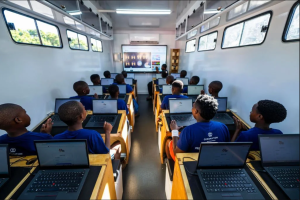
Breadline Africa has been working with under-resourced communities in South Africa for the past 28 years, converting shipping containers into functional classrooms, toilets, libraries and kitchens. While a key focus is improving the infrastructure at ECD centres, pre-and primary schools, Breadline Africa has run 44 successful feeding projects across 85 communities to help alleviate the hunger experienced by many families.
“For many households, families do not know how and when their next meal will land on the table, and for millions of children, school meals are often the only source of nutrition,” says Marion Wagner, director of Breadline Africa. “Many families are increasingly reliant on government grants and community-based feeding programmes to get their food.”
“It is important for us to ensure that while we focus on improving educational infrastructure, we cannot ignore hunger,” says Wagner. “Children are not able to fully focus on their work and learning on an empty stomach, and this is where our nutritional feeding partners along with community feeding programmes play such an important role.”
While the inability to focus on schoolwork may be a short-term issue, hunger and malnutrition can have long-term impacts on a child’s development. Even a slight nutritional deficiency can impair motor and cognitive development, affecting how a child may acquire social and physical skills. According to the World Health Organisation (WHO), inadequate nutrition is the most direct cause of stunted growth in children.
Before COVID-19, one in four children under the age of five were stunted for their age due to inadequate nutrition and not getting enough food and nutrients for healthy growth and development. However, following the pandemic’s start, one in six households reported that their children went hungry due to a lack of food. This increases the risk of stunted growth and impaired development.
“For all of our beneficiaries, a well-equipped kitchen and food supplies ensure that children can get at least one meal while at school,” says Wagner.
“We aim to continue providing for 12,000 meals a week and plan on placing another 117 feeding kitchens over the next few years. To do this, we need the support of individual and corporate donors,” says Wagner. “Benefits include tax certificates, enterprise development points, immediate social and environmental impact and branding opportunities even for partial donations.”
 Saturday Good News Wrap Up: A Million Acts of Kindness and So Much to Celebrate!
 Cape Town Kayakers Rescue Starving African Penguin Far Out to Sea
To find out more about Breadline Africa and their feeding programmes, visit https://breadlineafrica.org/
 by
by