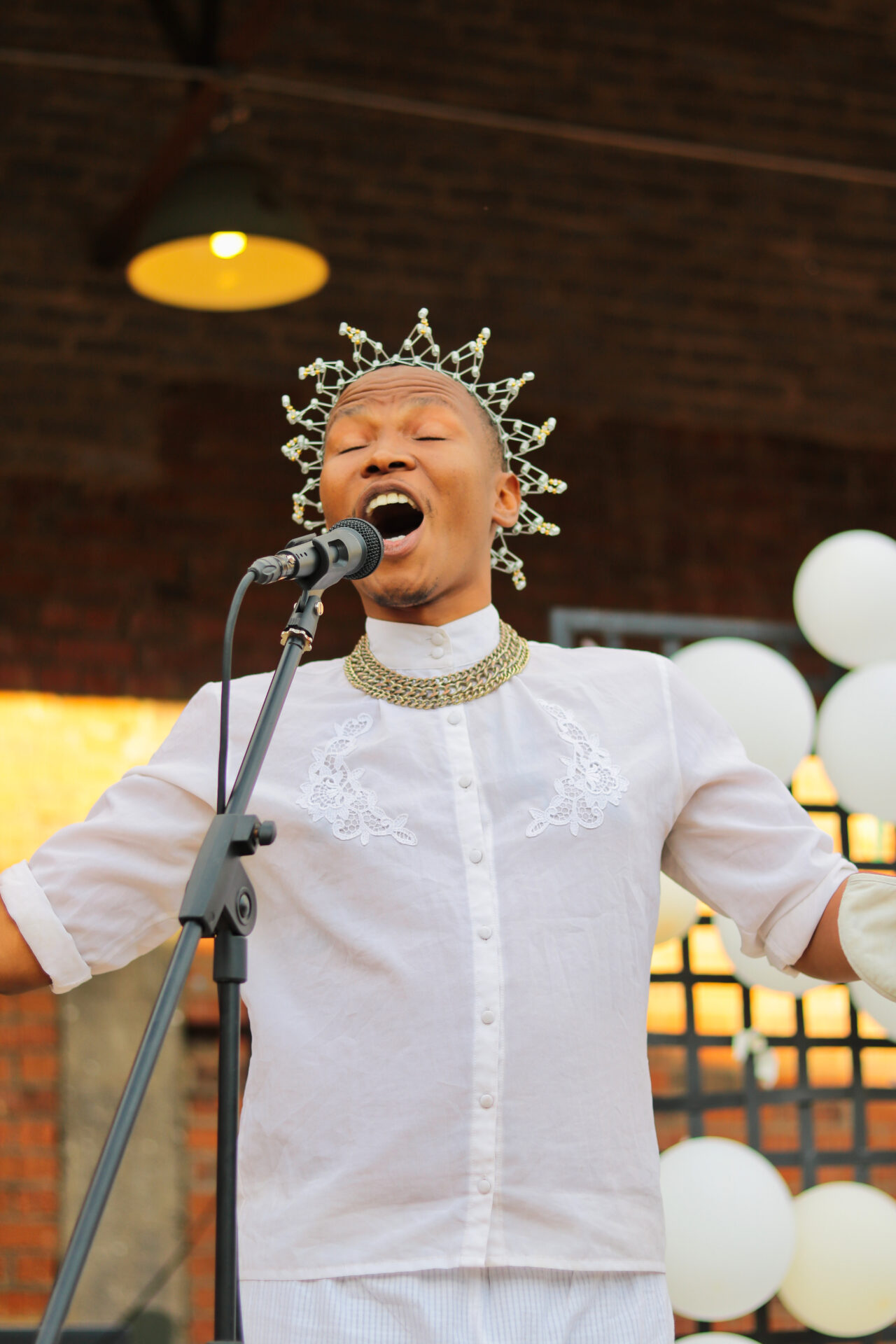
World Poetry Slam Champion Xabiso Vili shares how poetry, technology, and imagination are helping him reimagine African storytelling and inspire others to do the same.
.
South Africa (21 October 2025) – Words have a great deal of power, and when strung together, they can inspire, uplift and evoke deep emotions. Xabiso Vili is a talented, award-winning slam poet who sat down with us to share insights into his career and the opportunities afforded to him while working alongside the French Institute in South Africa (IFAS).
From Tsomo in the Eastern Cape, Xabiso Vili wears many hats. He is a poet, performer, producer, and digital dreamer, but they all point toward one purpose: storytelling that heals and connects. A World Poetry Slam Champion, Mail & Guardian Top 200 Young South African (2022), and Future Africa Grant recipient, Xabiso has made waves both on stage and online. As the founder and Executive Creative Director of Siziintsomi Creations, he’s building a creative incubator where art, innovation, and community meet. His goal is to push boundaries, blending poetry and technology in ways that reimagine how stories can move through the world.
Speaking to the inspiring young artist, we asked him how poetry became his chosen form of creativity. He shared that it was because he was a slightly awkward child growing up, and it was a way of expressing the quirky thoughts happening inside his head. Xabiso began writing everything down in journals, and not only has this been a great source for his poetry, but it has also been an aid in improving his mental health.
“I still learn from it every day, I still learn from my daily journaling, and I learn the kind of activism that poetry can create, the kind of change and shifts that poetry requires from me. It’s been a guiding light in terms of which side I want to stand on in history, it kind of shows it for me, and it gives me a voice to fight back.”
Xabiso has found his words becoming a tool for activism. At first, without even realising it, but once he noticed, he was able to go back to his writing and find his guiding point, speaking words into power and adding his voice to matters that spoke to him.
One of his poems, Forget How To Die became a winning moment at the World Poetry Slam Championship in 2022. This global recognition only further highlights the talent of South African poets.
“Poetry in South Africa was really some of the greatest work of poetry that I ever heard, growing up. So for me winning that Slam just from a South African context was just a reminder of these claims that we made, that we were some of the best poets in the world, it validated those.”
Over the past 10 years, Xabiso has privately written on his annual goal list, his hope to become one of the best poets in the world and 10 years later, that goal was reached.
“I think it was really a moment that cemented in me that following your dreams is a valid endeavour; becoming a professional spoken word poet from South Africa is a possibility.
Related Stories
The recognition is great, but I think it’s the capacity to dream bigger, to dream larger, not just for myself but also for a lot of my colleagues and peers within the poetry space, but also within the art community in South Africa.”
 PhD Student Leads Way in Exercise Oncology in South Africa!
 Anonymous Donor Gets Cat Angel Refuge Back on the Road With 5 New Tyres!
Collaboration is a big part of the arts, and for Xabiso, the chance to work with the IFAS was very empowering. He was invited to join IFAS’s 30th anniversary event, From Cooperation to Co-Creation: 30 Years of French Cultural Partnership in Southern Africa. Xabiso closed the evening with a specially created poem embodying the legacy of French–South African cultural partnerships, which he had penned during the event.
The poem was later recorded and shared online for those who couldn’t be there to hear it.
View this post on Instagram
Xabiso wanted to convey just how the collaboration with IFAS had given him the chance to collaborate without limitation, to tap into his imagination. Since 2019, when they first started their artistic relationship, things have really opened up for Xabiso; he has felt incredible support for his art. And now it’s not just about the past 30 years, but what the next 30 will look like.
“One thing that I’ve always really appreciated about IFAS is as much as they want to showcase African art in Europe, they also always want to bring that work back to South Africa, which not a lot of organisations consider when assisting in creating African art”
“Even when we were speaking about projects that engage with ancestry, time and mythology, IFAS has always kind of championed my works in that regard. And as much as some of these ideas that I do write about and want to bring to life might be completely crazy, they’ve never second-guessed and always just kind of double down on my madness, which I’m truly grateful for.”
Collaboration has afforded Xabiso and many other artists opportunities and the opening of doors, but most importantly, the chance to tell their own stories.
“Our imaginations become these spells where we can craft a future that we see for ourselves, especially for marginalised people, whose stories have constantly been taken from them; for them to be given space and capacity to reimagine stories with new technologies, I think for me that is the exciting part.”
On the subject of technology, Xabiso has been exploring how the spoken word and visuals can merge into a singular art form.
His exhibition Kwasukasukela, alongside Inka Kendzia, was an immersive projection mapping installation. It featured a fusion of AI, animation, projection, poetry, and African storytelling, which was used to rediscover ancient and contemporary origin stories.
While interviewing Xabiso, he shared his vision for a space that celebrates digital fireside tales. Creating new fables based on mythology that celebrate ancestry is something very close to his heart.
“I like to think that there’ll never be a time when man doesn’t look up into the sky and question where we all come from. For me, the poetry becomes that answer from the sky, that’s kind of where it comes from, and it enters you.
It places you in context and in community and in place and in time”“Even just in the past six years, from me having been dealing with the poetry within the digital space I’ve kind of had a trajectory I would have never even thought of, from going from augmented reality work like having images start to move and poetry playing from them to having entire short films projected onto a planetarium”
I’m really excited to be there on the ground and grow with it”
The future is filled with potential. For the poets still to come, Xabiso has several snippets of advice to share.
“My advice would be to collaborate; this is not stuff that I ever went to university for, but I was always able to find mentors and people who would be willing and able and ready to collaborate and learn with me and teach me as well”
The next snippet focuses on seizing major opportunities and pushing yourself to learn as much as possible within the grant space.
“Learn how to write grants – learn the language of applications. We have to figure out how to speak the language of money and large-scale funding, because as much as you might be paid for a gig or performance, it doesn’t compare to getting large-scale funding to run large-scale experiments”
Most importantly, it’s your story that matters most, so work on that!
“Right now we’re at a point where African storytelling is wanted by the entire world, so if you have a story to tell, somebody is out there ready to listen, so tell your story, unapologetically.”
This interview is part of a special partnership between the Embassy of France in South Africa, Lesotho and Malawi, the French Institute of South Africa (IFAS) and Good Things Guy, celebrating 30 years of cultural co-creation. Since 1995, IFAS, the cultural agency of the Embassy of France in South Africa, Lesotho and Malawi, has supported artistic and creative exchange across disciplines from visual arts to gaming.
To mark its 30th anniversary in 2025, IFAS and Good Things Guy are sharing the stories of South African creatives whose journeys have been shaped by French–South African cooperation, highlighting three decades of connection, creativity, and shared achievement. You can read them all here.
Sources: GTG Interview
Don’t ever miss the Good Things. Download the Good Things Guy App now on Apple or Google.
Do you have something to add to this story? Please share it in the comments or follow GoodThingsGuy on Facebook & Twitter to keep up to date with good news as it happens, or share your good news with us by clicking here or click the link below to listen to the Good Things Guy Podcast with Brent Lindeque – South Africa’s very own Good Things Guy. He’s on a mission to change what the world pays attention to, and he truly believes there’s good news around us. In the Good Things Guy podcast, you’ll meet these everyday heroes & hear their incredible stories:
Or watch an episode of Good Things TV below, a show created to offer South Africans balance in a world with what feels like constant bad news. We’re here to remind you that there are still so many good things happening in South Africa & we’ll leave you feeling a little more proudly South African.
 by
by