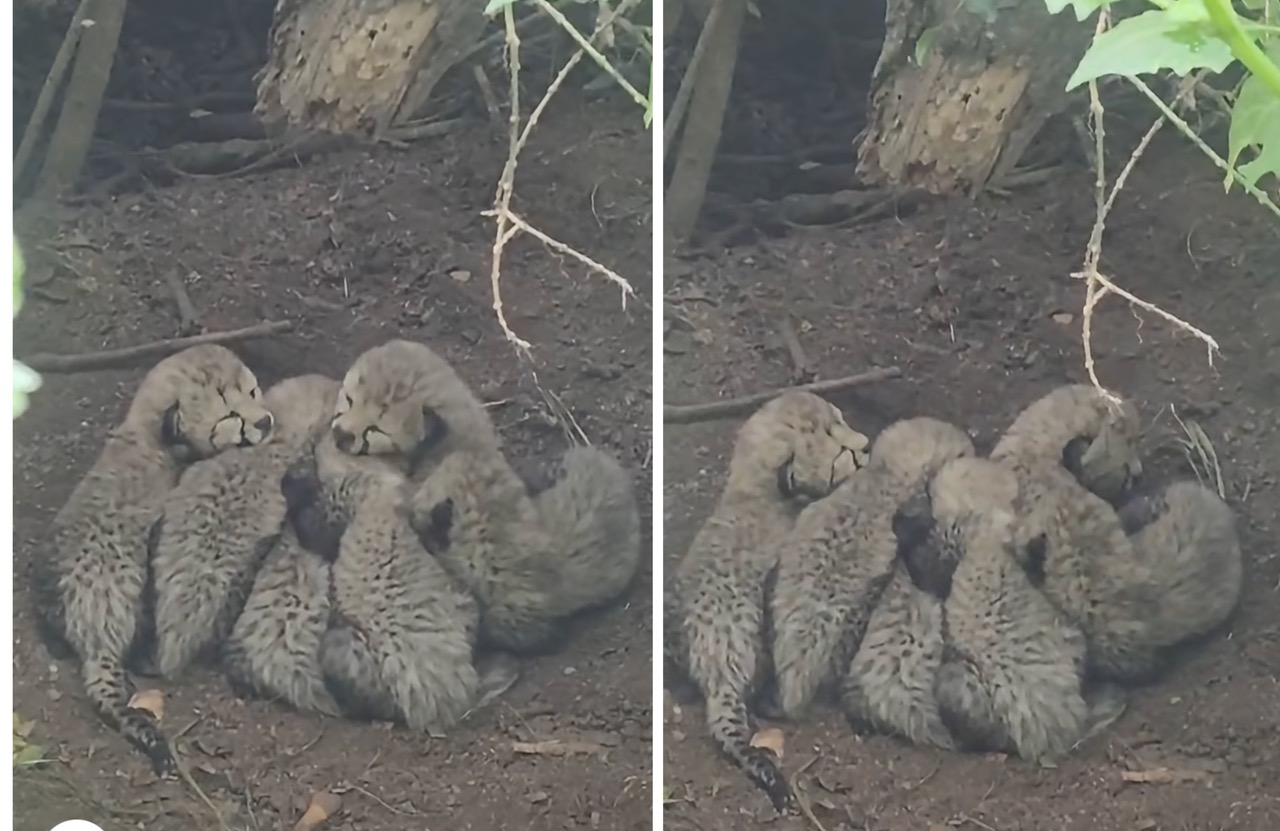
Six new spots of good news have arrived in the Eastern Cape! A cheetah mom has welcomed a litter of cubs. The little additions bring more hope for cheetah conservation in South Africa.
Eastern Cape, South Africa (04 September 2026) – There are six very small new faces to celebrate at Kariega Game Reserve after a female cheetah recently gave birth to a litter of six cubs!
Mum and her babies are doing well and are being closely monitored while they spend their first stretch of life together in a secure boma.
The extra care is especially important for their mom, who suffered a serious hunting injury shortly before giving birth. She has been receiving veterinary treatment and, while the injury has not completely healed just yet, she now gets to recover with six little ones keeping her very busy.
As lovely as the sight of six cheetah cubs is on its own, there is a much bigger reason to celebrate all those new spots.
Cheetahs are listed as a vulnerable species, and these cubs are part of South Africa’s managed cheetah population through the Endangered Wildlife Trust’s Cheetah Metapopulation Project. also known as the Cheetah Range Expansion Project. It is a conservation effort with a clever solution to one of the challenges facing our cheetahs.
Many of South Africa’s cheetahs live on fenced reserves. In a landscape without fences, cheetahs would naturally travel and disperse into different areas, meeting and breeding with animals from other populations along the way. This natural movement helps keep their genetics healthy and prevents populations from becoming too closely related.
A cheetah can’t hop a reserve fence when it is time to move on, though. So, the EWT helps them do the travelling.
Instead of looking at cheetahs on dozens of fenced reserves as completely separate groups, the project manages them as one big population. Cheetahs are carefully moved between participating reserves when needed, recreating the movement that would happen naturally in an open landscape.
Related Stories
 Two Dogs, One Happy Home: The De Lange Family Doubles Up on Love
 Genius Seaweed QR Code on Cape Town Beach Helps Save a Species!
Behind the scenes, there is also a huge amount of matchmaking homework involved. Births, deaths, genetics and individual animals are tracked so that conservationists can make decisions based on what will keep the wider population healthy for generations to come.
The project was formally established in 2011 and has since grown into the broader Cheetah Range Expansion Project. By the end of 2025, around 540 cheetahs of all ages formed part of South Africa’s managed metapopulation, while more than 700 translocations had been coordinated since 2012.
Those carefully managed moves have also helped cheetahs make a comeback beyond South Africa, with animals from the population contributing to conservation efforts in Malawi, Mozambique, Zambia and Zimbabwe.
Which makes six little cubs in the Eastern Cape much more than a most adorable new arrival. For now though, their biggest responsibilities are staying close to mom and doing lots of growing!
 by