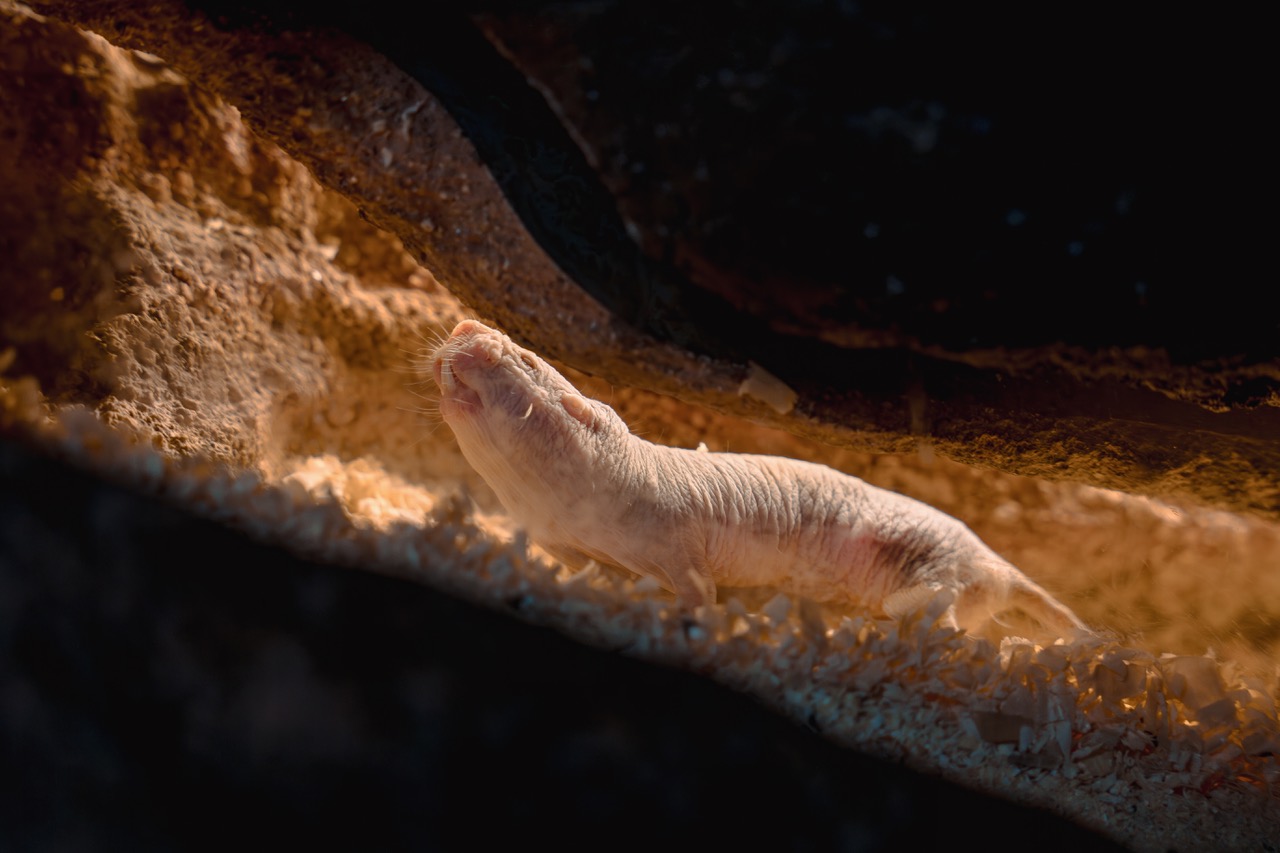
South African researchers have discovered how naked mole-rat queens use their scent to stop other females in the colony from breeding. This solves a biological mystery scientists have been puzzling over for decades!
Pretoria, South Africa (14 September 2026) – Did you know that naked mole-rats are actually stars of biomedical and behavioural science? Adding to a growing list of studies on the species’ behaviour and biology, researchers at the University of Pretoria (UP) have uncovered another remarkable secret about life underground.
The queen can use her scent to stop other females in the colony from breeding.
It’s a discovery that answers a question scientists have been trying to solve for decades. How does one female manage to remain the only one reproducing in a whole colony?
Naked mole-rats are among the very few mammals that live in a social system more commonly associated with bees, ants and termites. Usually, there is just one breeding female – the queen – while the other females remain infertile as long as she is around.
An international research team led by UP scientists has now identified an important part of how she maintains that control.
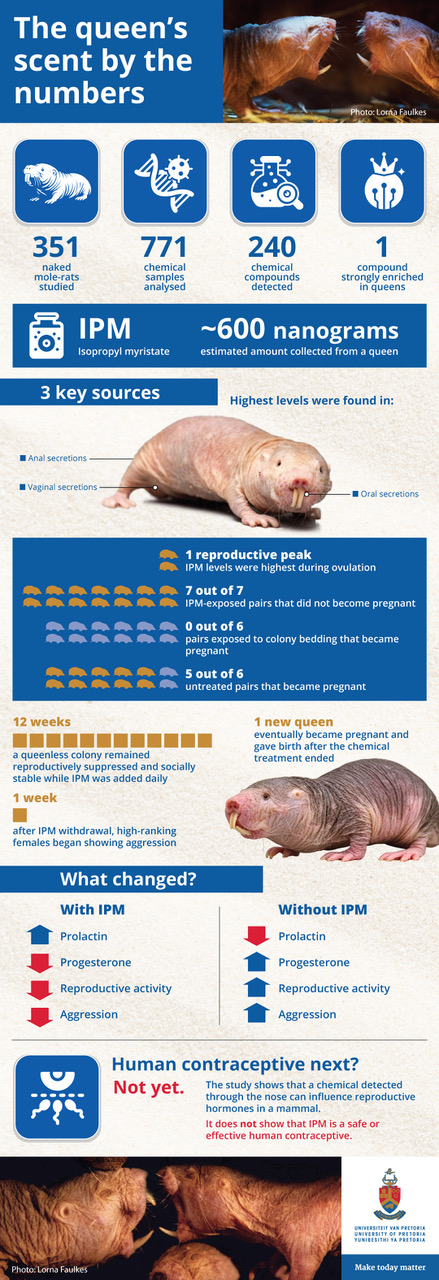
The study, published in Nature, found high levels of a chemical called isopropyl myristate (IPM) in breeding queens. It was almost completely absent in non-breeding adults.
“The queen produces an odour that enables her to be in charge,” said Prof Nigel Benne of UP’s Department of Zoology and Entomology in the Faculty of Natural and Agricultural Sciences. “That scent changes the reproductive hormones of the other colony members, and helps prevent both breeding and the violent competition that can follow when a queen isn’t close by.”
And things can get particularly tense underground when there is suddenly no queen.
Normally, her disappearance would see high-ranking females begin competing for the top spot, with fights sometimes becoming deadly as a new queen emerges.
Related Stories
 Volunteers Flown Into Boosmansbos Hack Over 5300 Pines Before Fire Season
 Give Hudson a Chance! SA Maker Turns Recycled Plastic Into Furniture
Researchers put the newly identified chemical to the test by removing a queen from her colony and adding IPM to the animals’ bedding each day.
For 12 weeks, the queenless colony remained remarkably calm. The females did not begin competing to reproduce, and the aggression normally expected after losing a queen did not take hold.
Chemically speaking, the absent monarch appeared still to be ruling.
Once researchers stopped adding IPM, that changed. Competition for a new queen began. and one female was killed. Another eventually became pregnant, gave birth and took over as queen.
“What’s particularly striking is that the compound did more than affect fertility,” said co-author Dr Daniel Hart. “When IPM was added to a colony after the queen had been removed, it delayed the reproductive competition and aggression that would usually follow queen removal or death. This suggests that the queen’s chemical signal helps maintain both reproductive order and social stability in the colony.”
A separate experiment added more weight to the finding. Researchers paired male and female naked mole-rats and exposed some of them to IPM. Five of the six untreated pairs became pregnant, while none of the seven pairs exposed to the chemical did.
The discovery has even raised an interesting question about where this kind of research could eventually lead.
Could scientists one day find ways to influence reproductive hormones through a chemical detected by the nose rather than a pill, injection or implant?
“There is a great deal of science still to be done,” Dr Hart said. “The important discovery is the pathway: a scent is detected by the brain, the hormonal system responds and reproduction is suppressed. Understanding that chain of events may eventually reveal possibilites that we cannot yet predict.”
Naked mole-rats have already given researchers plenty to investigate! The study forms part of a long-running body of UP-linked research into African mole-rats.
Researchers at the university have helped show how naked mole-rats survive conditions similar to a heart attack and resist bowel cancer, adding to a list of adaptations that include unusually slow ageing and natural reproductive suppression.
Collaborations involving UP have also investigated mole-rats’ resistance to acid, chilli-like heat and the chemical responsible for wasabi’s burn – work that could inform the development of new approaches to human pain management.
UP researchers have previously shown how naked mole-rats can survive ‘death’ by switching their metabolism during oxygen deprivation. Other research found that naked mole-rat colonies have their own learned vocal dialects, which help maintain colony identity and cohesion.
Together, these discoveries show why mole-rats have become unlikely stars of biomedical and behavioural science!
 by