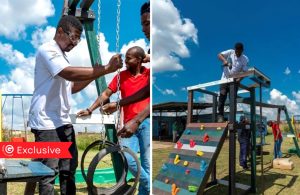
Stanley Msiska’s Maji website innovation achieved third place among 36 international solutions pitched at a global event.
Stellenbosch, South Africa (30 September 2022) – A digital application developed by an engineering student from Stellenbosch University (SU) that provides information about water quality in water supply systems took third place at a recent international gathering in New York, where more than 250 young leaders from 61 countries pitched solutions for sustainable development.
Stanley Chindikani Msiska, a PhD student at Stellenbosch University’s (SU) Faculty of Engineering, returned with great pride and excitement from Camp 2030, which is a project of Unite 2030, a non-profitable global youth community striving to achieve the United Nations’ Sustainable Development Goals (SDGs) by the year 2030.
Unite 2030 believes young people can succeed in achieving these SDGs, especially regarding the global challenges of poverty, inequality, injustice, climate change and water and sanitation.
“I’m overwhelmed that my innovation was selected by the judges as a winning solution. This is the news that I worked very hard for and hoped for,” Msiska said about his achievement. “I thank the Lord even more because this is the kind of success that is going to transform the lives of millions of people who live in despair and suffering.”
Msiska and Stefani Terblanche, a BA student in international studies, represented SU at this global event. The delegates were divided into 36 mixed groups that focused on different SDG challenges.
Msiska’s group came up with a website application, Maji, as a solution for the SDG for water and sanitation. “Maji” means water in Tumbuka, a language spoken in Northern Malawi. The app forms part of his postgraduate engineering studies at SU on existing water quality maintenance challenges in Malawi, his home country. He is also a lecturer in chemical engineering at the Malawian University of Technology and Sciences.

Mr Stanley Chindikani Msiska, a PhD Engineering student | Photo Cred: Supplied
Maji is a digital platform that provides maintenance services and information about water quality in water supply systems, especially in developing countries. The process will start by its first implementation in the Malawian capital, Lilongwe.
Msiska’s team members were Ashley Wunsch (Canada), Felipe Contreras (Mexico), Muskaan Waraich (Canada) and Inbar Erez (Israel). This team and Unite 2030’s support is backing him to get his innovation implemented.
“What captivates me, even more, is looking at how people and institutions are excited about the innovation and support its implementation,” said Msiska.
 A Saturday Feeding Scheme Opened Mahle's World to Her Dreams on the Soccer Field
 Nearly 1,000 Community Caregivers Gain Formal Qualifications to Strengthen SA's Child Protection
He didn’t want to disclose much detail about how Maji will work because the patent had not been registered yet. However, he was willing to reveal that the Maji web app will operate on smartphones, computers and even through text messages if there is no internet.
Msiska said that this innovation will also address the challenge of unemployment.
“The digital platform will create jobs because community members will be employed for data collection about water and systems. “I will now be actively involved with stakeholders in implementing Maji.”
He added that he needs further support as the implementation will require more resources.
Terblanche was also overwhelmed by her “amazing experience” at Camp 2030 and by her group, which focused on finding solutions for gender-based violence and gender inequality.
“It was so interesting learning about other cultures and countries on such a scale, and hearing what people are doing within their communities and the world. I also learned about the different issues that different people face regarding gender-based discrimination in the workplace, women’s health rights, trans-healthcare issues and more,” Terblanche said.
Noel Bekkers, Head of the Concordia Residence where Msiska is a resident, congratulated him on his achievement and praised him for his commitment to his PhD studies and his passion for accepting challenging assignments as an academic and an entrepreneur.
Bekkers credited various staff members for their additional efforts to enable Msiska and Terblanche to attend Camp 2030, especially Michelle Pietersen, programme manager at the Division of Social Impact, for making last-minute arrangements.
 by