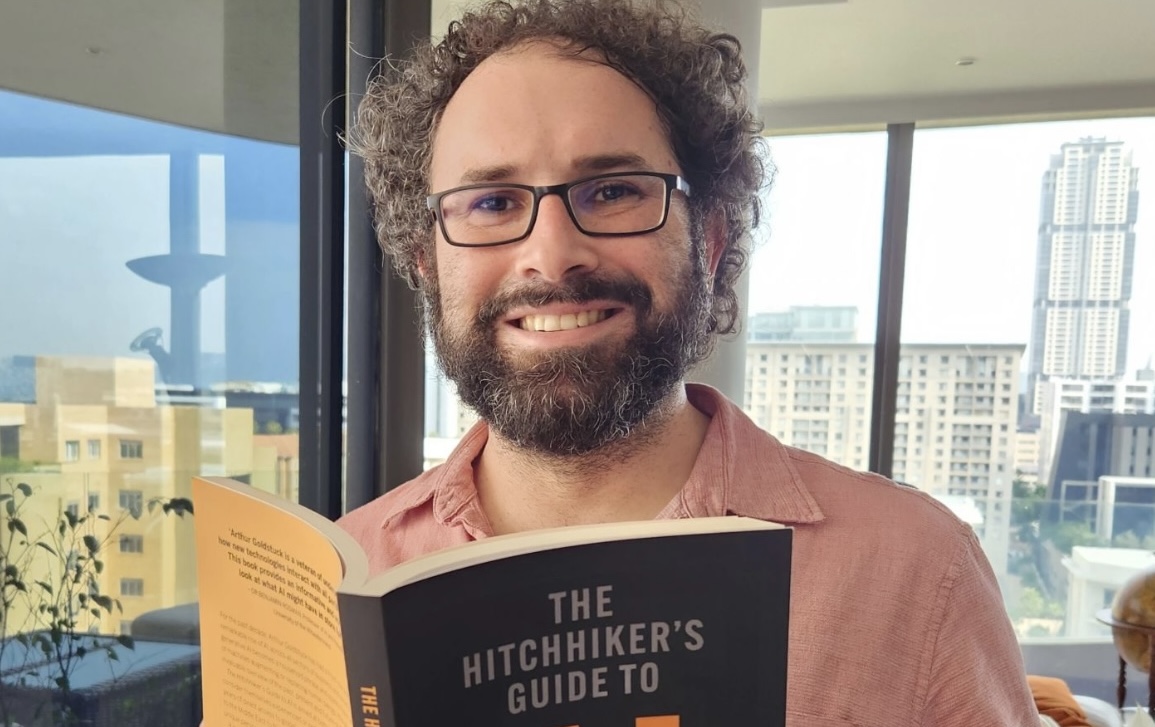
Benjamin Rosman of Wits University is challenging assumptions about Africa’s role in AI and building a hub for curiosity-driven research; now he features in Time Magazine, too.
Johannesburg, South Africa (05 September 2025) – What do Elon Musk, Mark Zuckerberg, and Benjamin Rosman have in common? Well, for starters, they all made it onto Time Magazine’s list of people shaping the future of artificial intelligence. Yes, Benjamin Rosman, a professor from the University of the Witwatersrand, right here in South Africa, has been recognised alongside the giants of tech.
“It was a lot of impostor syndrome,” he says. “It still feels very surreal… but also kind of mind-blowing.”
Professor Rosman is equally famous for his blunt take on what he calls the “African angle” question in AI. For years, people have asked him about Africa’s contributions to the field, usually pointing to African languages, healthcare, or financial inclusion. While those are important, Professor Rosman pushes back the assumption that Africa’s role is somehow secondary.
“For the longest time, when people ask what the African angle on AI is, the answer often comes down to things like AI for African languages, or financial inclusion, or healthcare,” he explains. “And that’s fine, these are really important areas. But even just the framing of that question is limiting. We’re developing technology, building the future. We can contribute to AI itself, not just its applications.”
This approach is what drives the Machine Intelligence and Neural Discovery (MIND) Institute at Wits, which Rosman launched to bring together academics from across the university, including philosophers, neuroanatomists, and policy experts. MIND encourages curiosity-driven research and ambitious projects; from studying how culture affects human-robot interaction, to investigating how sleep deprivation affects AI and what that can reveal about human and machine behaviour.
Professor Rosman is also quick to point out that Africa’s AI community is buzzing. Through initiatives like Deep Learning Indaba, researchers across the continent are connecting, collaborating, and building momentum.
“There are incredible students, academics, and startups across Africa,” he says. “We just need to connect more of the pieces and turn the dial up to 11. If we do that, Africa won’t just be part of the conversation, we’ll help lead it.”
Despite the global recognition, Prof Rosman remains grounded. Being named in Time alongside some of the biggest names in tech has not gone to his head yet.
“It’s humbling,” he admits. “But also, it shows that the ideas we’ve been pushing really do matter.”
 A Global First for South Africa and Better Kidney Care
 “Thank You, Durban” Delfi Family Shares Emotional Update 2 Weeks After Fire!
Sources: GTG Interview / Time Magazine
Don’t ever miss the Good Things. Download the Good Things Guy App now on Apple or Google.
Do you have something to add to this story? Please share it in the comments or follow GoodThingsGuy on Facebook & Twitter to keep up to date with good news as it happens, or share your good news with us by clicking here or click the link below to listen to the Good Things Guy Podcast with Brent Lindeque – South Africa’s very own Good Things Guy. He’s on a mission to change what the world pays attention to, and he truly believes there’s good news around us. In the Good Things Guy podcast, you’ll meet these everyday heroes & hear their incredible stories:
Or watch an episode of Good Things TV below, a show created to offer South Africans balance in a world with what feels like constant bad news. We’re here to remind you that there are still so many good things happening in South Africa & we’ll leave you feeling a little more proudly South African.
 by
by