


The Overberg Renosterveld Conservation Trust along with local farmers and various stakeholders, have started restoring damaged landscapes in the area.
Overberg, South Africa (17 August 2023) – Ecosystems can be damaged, suffer degradation or even be irreversibly destroyed. As the human footprint expands, as a direct result of our need for survival as well as our insatiable greed, our impact on ecosystems is increasing exponentially.
According to Grant Forbes, Conservation Manager at the Overberg Renosterveld Conservation Trust, “Over the last century, the loss of natural areas has increased at a rapid rate, and this hasn’t halted yet.” He pins this on a suite of factors, including industrial and housing developments, agriculture, unsustainable use of natural resources and the spread of invasive species. In fact, about 40% of the earth’s surface has been destroyed or degraded, we have lost about 67% of our wildlife and 3.2 billion people are impacted as a result of our own actions.
Global interventions required
Restoration of ecosystems is needed globally. But the meaning of restoration has changed dramatically over time. Historically, restoration focused on the recovery of transformed areas like old agricultural lands or decommissioned mines. These would include activities to help the system regenerate and create suitable conditions for macro and micro-organisms to return and the abiotic process to ‘restart’.
Grant says, “Today, however, restoration ecology considers a wider range of activities. The United Nations, as part of their Decade on Ecosystem Restoration (from 2021-2030) highlights our need to prevent, halt and reverse the degradation of ecosystems on every continent and in every ocean.”
In fact, the first rule of restoration is to do no harm – a key principle of the work of the Overberg Renosterveld Conservation Trust. But once that first rule is broken and existing habitat has been impacted, then restoration can be as simple as removing invasive plant species, reintroducing a lost process like fire or grazing, or as complex as landscape engineering to repair, for example, severely eroded areas.
Long-term recovery is needed
“Interventions may catalyse the recovery process but full recovery to its new or preferred state will take years, even decades to centuries. Restoration creates the platform for recolonization but we can never step away – outside factors like climate or other anthropogenic impacts might call for a reassessment of the process in order to adapt or implement additional activities during the restoration period. Therefore, restoration continues as the ecosystem recovers.”
Restoration and conservation also go hand in hand. Conservation of our natural environment needs to continue as we look at restoring areas to support ecological processes and functioning. This is of particular importance in severely threatened and degraded ecosystems such as renosterveld in the Overberg, where extensive levels of degradation and transformation occurred. In fact, the threat is so great that renosterveld here has been listed as Critically Endangered, with only around five percent of its original extent remaining.
He adds, “As humans, we need to take responsibility for the wrongs of the past and give priority to the preservation of virgin land, and the restoration of degraded ecosystems and transformed areas. This is crucial for the survival of humanity.”
Working with the custodians of the veld
In the Overberg Rûens, the ORCT works in partnership with the custodians of renosterveld to implement crucial management interventions which support restoration. The stewards of renosterveld, the Overberg farmers, are key partners to the vision and mission of the ORCT and the conservation and restoration of Overberg renosterveld.
This includes the management of grazing and fire as landscape drivers, the eradication of invasive species and the restoration of degraded watercourses and other areas to establish corridors which connect remnants and facilitate the movement of wildlife and preserve ecological integrity. It has also included a number of novel restoration activities that the ORCT team are testing.

Sausages to the rescue
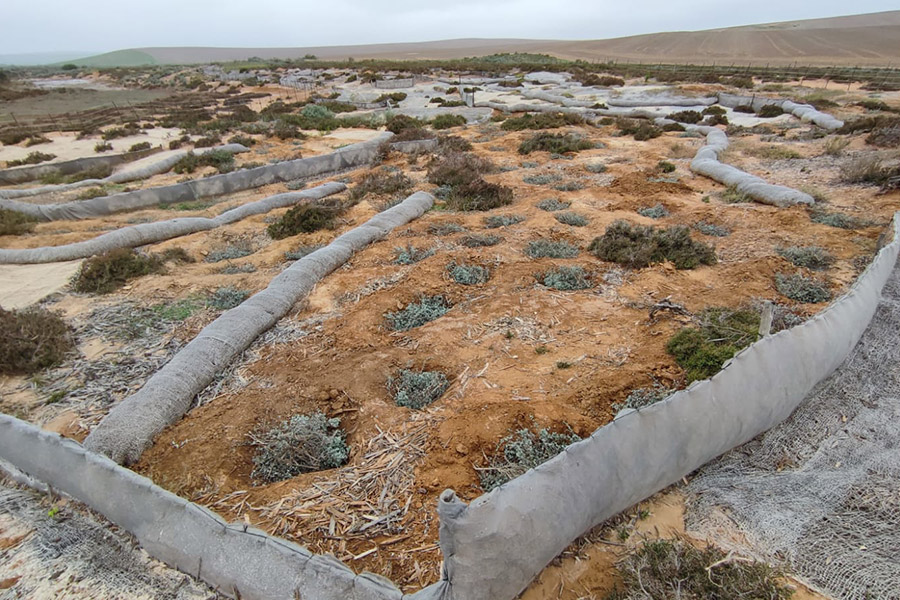
According to ORCT Director Odette Curtis-Scott, “We’re testing experimental restoration on eroded habitat in watercourses. This includes using soil blankets, old fencing poles and blue gum poles to stabilise slopes. Erosion sausages have been fixed to steep banks to slow the waterflow and facilitate the build-up of sediment. This in turn has created favourable areas for seed establishment. We’ve also seeded some sites with a few local species, including a pioneer seedling mix of grasses and shrubs indigenous to the area. And in the coming years, more novel restoration methods will be adopted to test in renosterveld.”
Even with these activities, while interventions like this will catalyse the recovery process, full recovery to its new or preferred state could take years, or even decades to centuries.
Odette adds, “Despite this, no fragment is too insignificant to restore, given the important role even these small fragments play as corridors or stepping stones for the movement of renosterveld-dependent wildlife.”
 by
by 