


Renatha was the first deaf child in SA to receive a cochlear implant. Nearly four decades later, she’s just become the first deaf student at UFS to submit a thesis entirely in sign language!
Free State, South Africa (19 April 2026) – A little girl in South Africa made medical history in 1987 when she became the first deaf child in the country to receive a cochlear implant.
Thirty-eight years later, Renatha van Reenen has made history once again. This week, she walked across the graduation stage at the University of the Free State as the first deaf student there to complete a Master of Arts in South African Sign Language and Deaf Studies.
That alone is cause to celebrate, but the way she did it is even more extraordinary.
Instead of submitting a traditional written dissertation, she presented her entire thesis in South African Sign Language in a series of recorded videos. The whole thing including arguments, findings, references, and structure was captured on camera in sign language!
Renatha grew up in a world that regularly asked her to adapt, working around systems that weren’t designed for her. A school talk by deaf activist Johan Gouws in 1998 sparked what ultimately led her to wanting to become a champion for deaf people.
She went on to spend seven years as an assistant teacher at a deaf school, and advanced her studies at the University of the Free State where she became a language facilitator in the university’s Department of South African Sign Language and Deaf Studies.
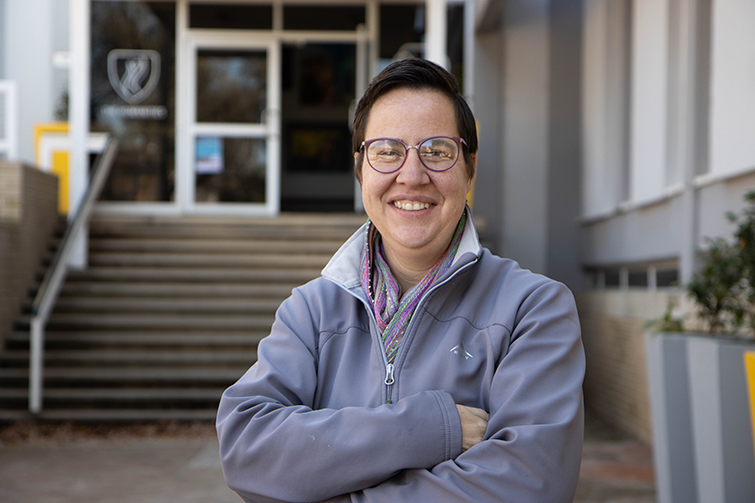
Her research, interestingly, zeros in on mouth movements in sign language. The way deaf signers use their lips and facial expressions does plenty of linguistic heavy lifting, Renatha wanted to document how those patterns shift depending on social context and communication needs.
“Sign language is not only about hand shapes and movements. It is a full visual language where facial expressions and mouth patterns carry grammatical and linguistic significance,” she explains, as per UFS.
Filming a thesis is not the same as typing one, it is far more complicated. Written work can be tweaked in seconds but sign language can’t. Every revision meant going back in front of the camera and filming entire sections again from scratch. She spent a lot of time integrating subtitles for academic references and visual aids like graphs directly into the footage. The process required navigating multiple rounds of revision, ethics approval, external examination and constant coordination with interpreters just to have conversations with her supervisors.
“Unlike written work where revisions can be made easily, working in SASL required careful preparation, repetition, and sustained focus,” she shares.
She also had to engage deeply with English academic literature by formulating complex arguments in writing before translating them into her native language. In other words, she essentially conducted advanced research across two languages simultaneously!
Renatha is passionate about deaf students being empowered to embrace who they are rather than accommodate a world that underestimates them. She’s interested in different sign languages around the world, in how deaf children are supported in schools, and in the bigger questions around what deaf communities need to thrive.
She’s not interested in pity, and she’s not interested in being the exception.
“We are not limited by being deaf — society is limited when it fails to recognise our full potential.”
 by
by 