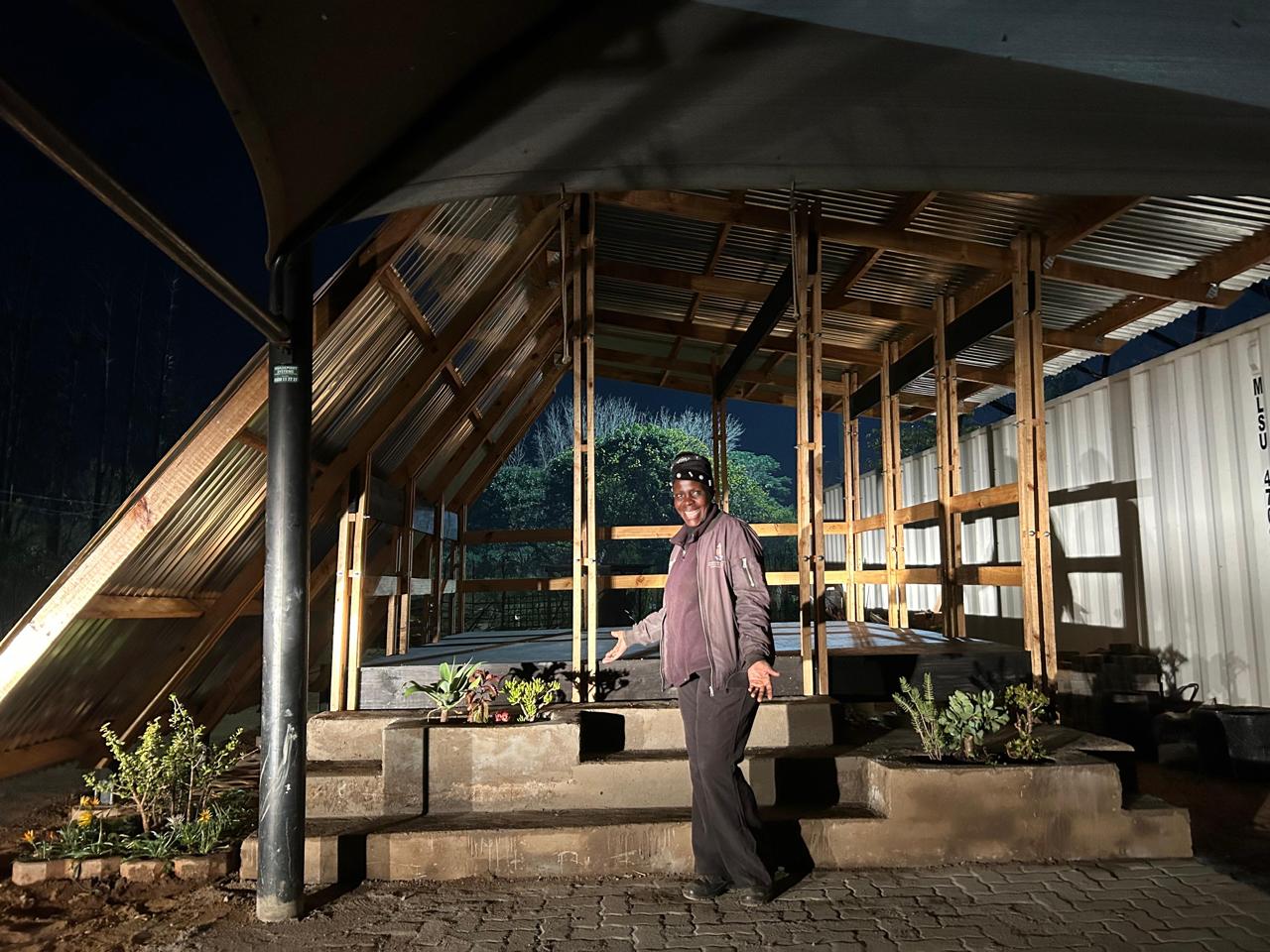
The University of Pretoria architecture honours students joined forces with members of Melusi informal settlement to create an award-winning centre that is significantly improving the lives of its community.
Pretoria, South Africa (15 December 2025) – Where there once stood an abandoned shack in the Melusi informal settlement west of Pretoria, now stands an award-winning, timber-clad youth centre.
Named the MYDO 2 Building, this small meeting place of about 6.6 metres by 3.2 metres enables the Melusi Youth Development Organisation (MYDO) to offer more important services to the sprawling community.
The building is one of two new structures, designed by University of Pretoria (UP) Architecture Honours students in partnership with local community members, and recently received a Maverick Prize at the national Timber Design Competition.
The MYDO 2 co-design project took off when residents and UP Architecture students joined forces to dream up ways of improving Melusi residents’ living conditions. Together, they began designing and building two projects: an extension of the youth centre and an addition to the neighbouring Community-Oriented Primary Care (COPC) Clinic.
Thanks to their team effort, community members can now socialise in the newly erected timber-frame satellite youth development centre and take shelter at a dignified waiting area when they visit the clinic.
The timber-frame buildings and concrete footing centres were designed in such a way that they can be easily disassembled, removed and relocated elsewhere if the settlement is upgraded.
The university’s community engagement footprint in various informal settlements in Gauteng extends back many years. In Melusi, it includes involvement in the COPC Clinic, providing healthcare and other services to the local community, as well as a collaboration with the neighbouring MYDO.
“Through our lengthy needs analysis process and discussions with community representatives, we learnt about the real need for two structures: a sheltered, private waiting area for patients who visit the clinic, as well as an extension of the youth centre in the isolated western part of Melusi,” Oberholster says.
“The new clinic space can now also be used for outdoor screenings and health talks, to extend the clinic’s operational abilities.”
 SPAR Women’s Challenge Funds Turned Into GBV Prevention Programme
 Street Lines 2026 Showcases the Best of South African Skateboarding
Sara “Mamthembu” Mojapelo, Caretaker at the COPC Clinic, is proud of her involvement in the process. She says the people of Melusi are very thankful for the new addition, as it allows clinic services to continue even on rainy days.
“Adding value isn’t about how much you do – it’s just about choosing to do something,” she says.
Extending the reach to youth
The involvement of UP Architecture students and staff is part of the Co-Creating Wellness and Human Dignity Research Project run by the Unit for Urban Citizenship in UP’s Department of Architecture. The project is supported by the South African Agency for Science and Technology Advancement (SAASTA), a business unit of the National Research Foundation, through funding received from the Department of Science, Technology and Innovation (DSTI).
According to Project Lead and Head of the UP Department of Architecture Prof Carin Combrinck, the multi-year transdisciplinary collaborative project aims to address complex socio-spatial challenges within informal settlements in Tshwane.
Senior researchers from various UP faculties, honours and master’s students in Architecture, interns and community field researchers have worked together in Melusi since 2023. Their endeavours started with regular workshops to thoroughly assess the real needs of the community in terms of health, well-being and socio-spatial justice.
The settlement was extensively documented, and the built environments and social issues were mapped.
Prof Combrinck says such a participatory approach ensures that the voices and needs of the community are directly heard.
“These interventions not only meet immediate community needs but also contribute to incremental urban upgrading, reflecting both academic rigour and practical relevance. It also teaches our students more about community involvement,” Oberholster adds.

Manuals available for free
As part of their commitment, the students drew up building manuals for the two structures, publications which are open source and thus available for free to those who want to replicate their builds.
Co-created community action plans, as an extension of the participatory process, have also been drafted. Prof Combrinck believes these will go a long way in informing the Tshwane municipality’s plans for the settlement’s future, and could help relieve systemic inequalities reflected in the proliferation of informal housing areas.
“The action plans were developed based on the community’s needs, challenges and strengths, and how they see the future of Melusi. The plans serve as tangible frameworks for addressing spatial injustice in ways that reflect the lived realities and aspirations of the community itself,” she says.
“With such plans in hand, community members can now provide meaningful proof of their needs when engaging with the local municipality. We believe this will help tailor service delivery, possible upgrades, and other endeavours accordingly, to help relieve the burden of incremental informal settlement upgrading.”

Sources: University of Pretoria
Don’t ever miss the Good Things. Download the Good Things Guy App now on Apple or Google.
Do you have something to add to this story? Please share it in the comments or follow GoodThingsGuy on Facebook and Twitter to keep up to date with good news as it happens, or share your good news with us by clicking here or click the link below to listen to the Good Things Guy Podcast with Brent Lindeque – South Africa’s very own Good Things Guy. He’s on a mission to change what the world pays attention to, and he truly believes there’s good news around us. In the Good Things Guy podcast, you’ll meet these everyday heroes and hear their incredible stories:
Or catch an episode of Good Things with Brent Lindeque or our Weekly Top 5 below. The videos here are always changing, updated with the latest episodes from these two shows. Both are part of Good Things TV, created to bring South Africans balance at a time when the news can feel overwhelmingly negative. Our goal is simple: to remind you that there are still so many good things happening in our country – and to leave you feeling a little more proudly South African.
 by
by