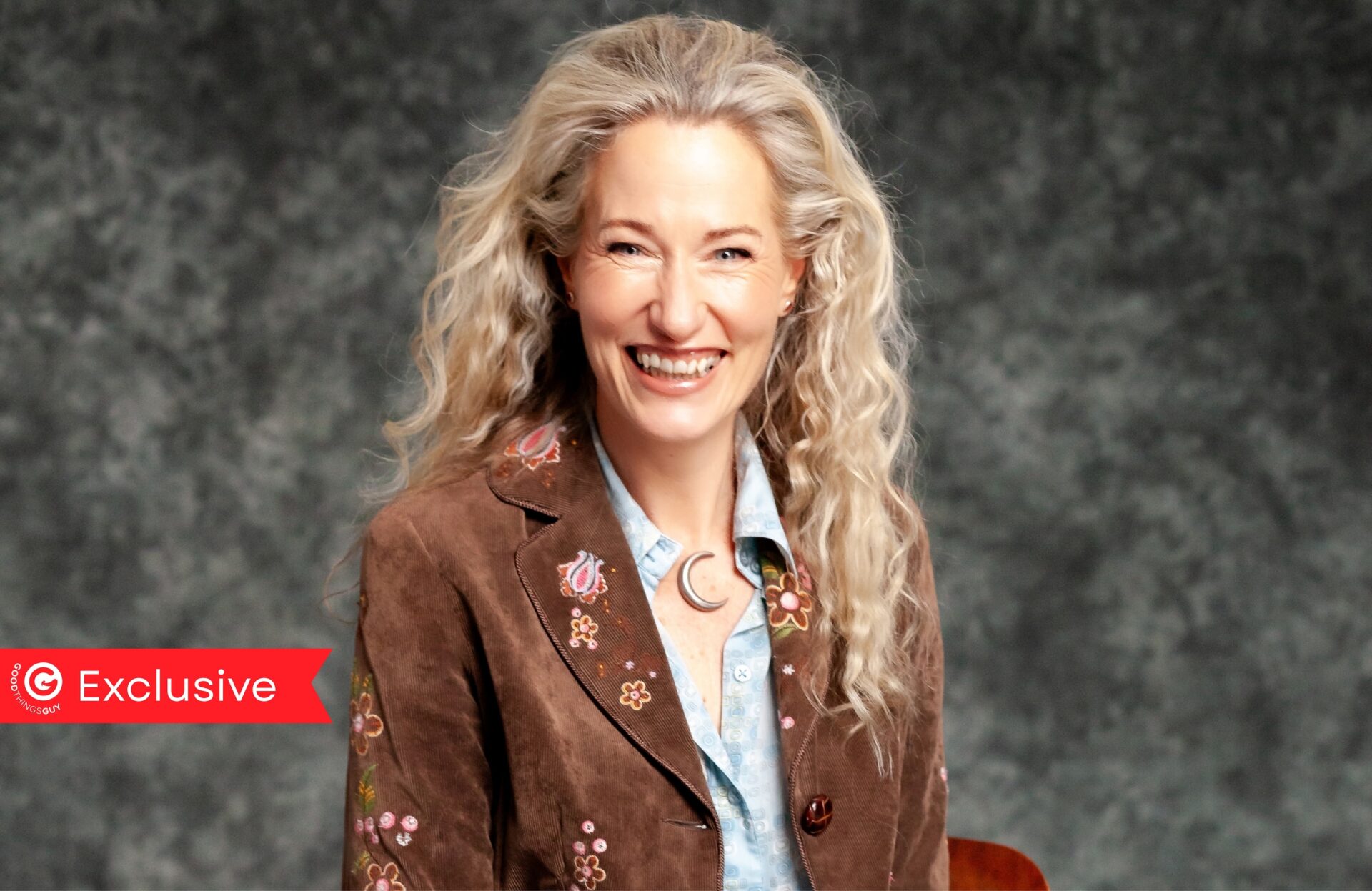
Stefanie de Beer’s work brings endangered species back into our shared space, asking us to look closer, care deeper and recognise our role in what happens next.
South Africa (14 March 2026) – Stefanie de Beer is an artist working against disappearance. Her practice is shaped by what is vanishing from our landscapes and coastlines, and by a belief that visibility can still change outcomes.
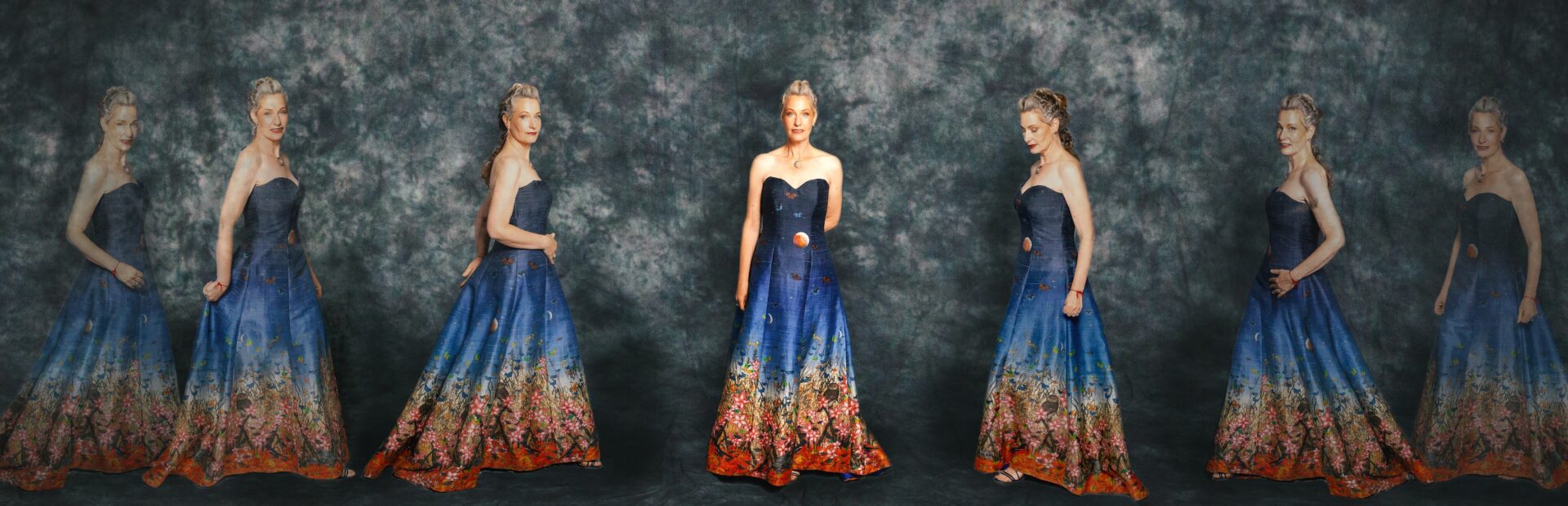
Using sculpture, printmaking and wearable art, she places endangered species back into the human line of sight, creating encounters that are felt before they are understood and remembered long after they are seen.
What becomes clear early on is that this work did not arrive suddenly. It has been gathering momentum for years, informed by training, experience and a growing sense that aesthetics alone were never going to be enough. Stefanie’s academic grounding in Fine Arts, Visual Communication and Entertainment Technology equipped her to understand how images carry meaning, how narratives are shaped and how attention can be directed.
For her, the move towards environmental work was not a shift in direction, but a clarification of purpose.
“Those disciplines were never only about aesthetics. They were about narrative and impact,” she explained in a recent interview.
“I was trained to think conceptually, to communicate clearly and to understand how visual language shapes perception. The environmental direction wasn’t a deviation. It was an alignment.”
That alignment sharpened in September 2024 during a Heritage Day collaboration with the Mabula Ground Hornbill Project in Pretoria. The activation involved a large-scale, live industrial lino and wood-carve print, created in a public space as both artwork and advocacy. It was during that event that a conversation about Botha’s Lark fundamentally changed the trajectory of her practice.
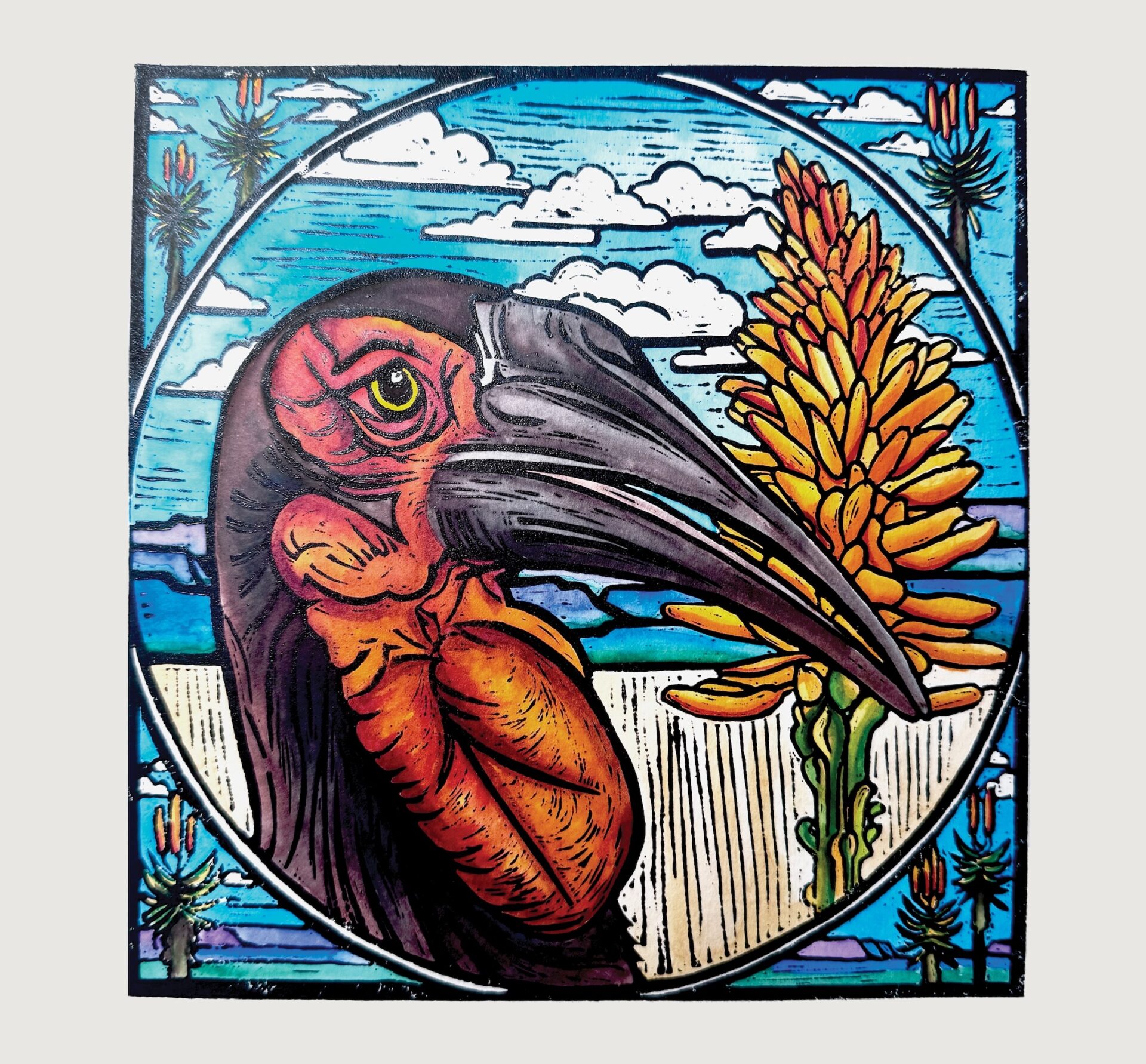
The bird, reduced to roughly 340 individuals in South Africa, depends on a fragile grassland system in Mpumalanga and does not easily relocate. Hearing its story reframed abstraction into urgency.
“The reality of a species reduced to that number landed with force. A bird that doesn’t move easily, dependent on an ecosystem that’s changing fast. That moment opened the floodgates.”
 They Made It! Young Animal Welfare Volunteers Off to Cape Town
 This Dog Saw Humanity at Its Cruellest – Then Came a Little Girl With R15
From there, the work unfolded with pace and intention. Small Art for Botha’s Lark followed in support of BirdLife South Africa. Soon after came The Protected Pack, centred on African Wild Dogs, and The Huddle, focused on African Penguins. Rather than feeling forced or opportunistic, the projects emerged as if they had been waiting for the right moment to surface.
Scale plays a critical role in how Stefanie communicates urgency. Her public installations bring endangered animals into shared spaces at true-to-life size, removing the emotional buffer that distance so often provides. African Wild Dogs and Cape Penguins are no longer reduced to photographs or statistics; they stand at human height, occupying the same physical space as the viewer.
“When an animal stands at your height, it becomes harder to ignore. You’re no longer engaging with an idea. You’re encountering a presence.”
That same sense of intention carries into her printmaking, where intimacy replaces monumentality without losing impact. Species such as the Southern Ground Hornbill and Botha’s Lark are carved with precision and care, selected not only for their symbolism, but also for the ecological roles they play and the fragile systems they sustain. The work asks for time and attention, rewarding those who stop to really look.
At the centre of Stefanie’s practice is purpose, not medium. Sculpture, printmaking, couture and workshops are simply tools for the same underlying aim: to reconnect people to what is being lost and to their role in that loss.
“The thread is always the same. To make the invisible visible, and to restore the bonds between beauty, story and survival.”
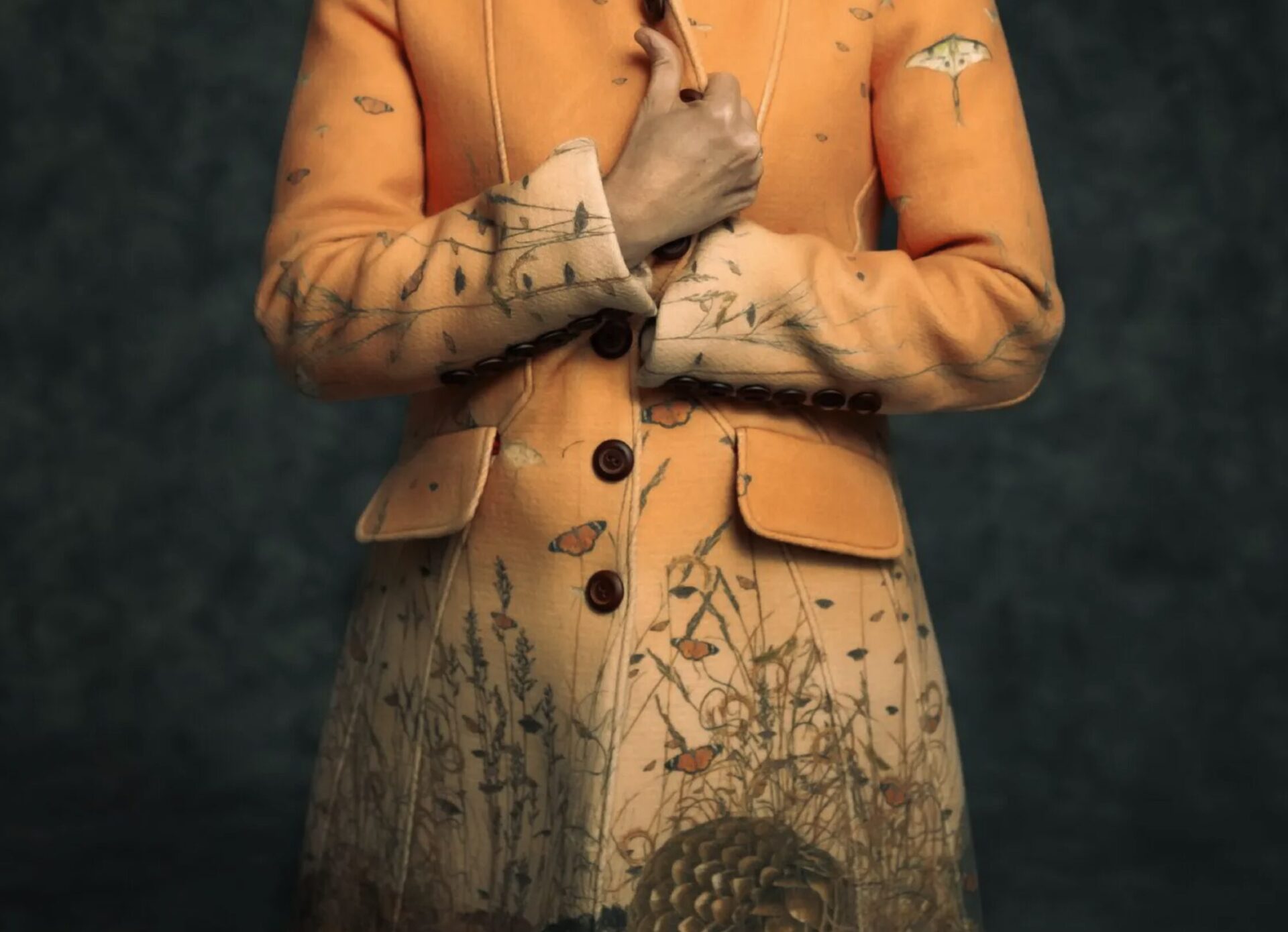
That thinking extends to materials. In her wearable works, Stefanie places strong emphasis on traceability and origin, working with what she describes as the long language of land. Wool becomes more than fabric; it becomes a record of place.
“Sheep walk across veld and gather fragments of that terrain into their coats. When you know where the wool comes from, you know where the sheep comes from, and you begin to understand the landscape that shaped it. Materials carry lineage.”
Some of her most confronting works take this even further, using materials directly associated with harm. Sculptures created from snares collected in the bush carry both physical and emotional weight. Before they are transformed, the tightening loop is removed… an intentional act that alters the object’s meaning before it becomes art.
“When I initially took up the work of sculpting with snares, I did not realise how heavy a snare could be. I also did not understand how important it would become for me to cut off the end that actually ensnares. That tightening loop is the functional part. It is the part designed to trap. Removing it is a significant act. It changes the object before it becomes anything else,” Stefanie says.
“It is a big job. Far more emotionally demanding than it is physically demanding.”


Underlying this work is a question that has stayed with Stefanie for years: what did you do once you knew? It is a question she does not attempt to answer neatly, but one she continues to explore through form.
“Once you understand the scale of the snare crisis, you cannot unknow it. Transforming snares into sculpture is my way of responding to that reality. When I transform a snare into a sculpture, I am translating an answer to that question. It is a visual translation. It is taking an object designed to harm and reshaping it into something that can create a connection. My hope is that there is a layer of understanding that forms between the work and the viewer.”
Research anchors every project. Stefanie spends long periods reading, speaking directly with conservationists, photographing her subjects and immersing herself in the environments she references. Observation, she believes, informs intuition.
“You charge your gut by really looking. The more time you spend observing, the more informed your intuition becomes.”
Some ideas take years to reach resolution. If a concept feels thin or unresolved, it is left alone until the understanding deepens.
“If it’s mine to work with, it won’t go away.”
Impact, for Stefanie, must be tangible. Twenty-five percent of every artwork sold goes directly to biodiversity protection, ensuring the work contributes meaningfully to conservation efforts rather than stopping at awareness.
“Impact that lives only in abstraction is too easy to hide behind. I want to be able to answer clearly what the work actually changed.”
When people encounter her work, the hope is not overwhelm or despair, but responsibility. A shift from passive concern to active care. An understanding that even small, conscious actions matter.
“When you have the choice to support or not support, choose to support. Small actions, done consistently, gather momentum.”
Even her aspirational projects follow this same logic. Polar, which imagines mirrored aluminium polar bears placed in desert dunes, uses contrast to collapse distance and reflect the issue back at the viewer.
“A polar bear doesn’t belong in a desert. That dislocation is the point,” she explains.
“The work is intended as a commentary on oil, on extraction, and on the relentless appetite for more. More fuel. More production. More consumption. The polar bear has become one of the most visible indicators of climate instability. Melting sea ice directly affects its ability to hunt and survive. The urgency is real and measurable. By placing a mirrored aluminium polar bear in a desert, I want the viewer to confront contrast. Ice in sand. North in South. Cold in heat. The mirrored surface would reflect the landscape and the viewer back at themselves. It becomes harder to separate the issue from our own participation in the systems that drive it.”
And it is this visibility in all her artwork that can still lead to insight. Insight that can still lead to responsibility. And responsibility, acted on with intention, can still protect what remains. That belief sits at the heart of her work, and it is what makes encountering it feel less like observation and more like participation.
Action, taken with intention, can still protect what remains.
 by
by