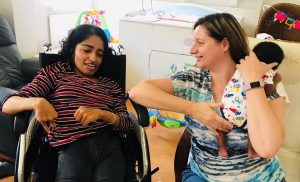
This isn’t just a story about homelessness. It’s a story about humanity. And it begins with Mandy-Lee, a woman who couldn’t turn her back on pain… even when it wasn’t her own.
Pretoria, South Africa (01 June 2025) – It started with a TikTok. A short, quiet video of two South Africans, Hermanus and Anell, who’d been offered jobs in new provinces, uprooted their lives with hope in their hearts… only to find the companies they worked for had shut down. No notice. No pay. No backup plan. They were now living on the streets.
Most people would’ve watched, felt sad and kept scrolling.
But Mandy-Lee Fourie isn’t most people.
She watched. She cried. Then she picked up the phone and asked a simple, powerful question, “What can I do to help?”
It wasn’t just that the video moved her; it was why. The heartbreak she saw in their eyes mirrored something inside her. Something familiar. Mandy-Lee didn’t just feel their pain. She knew it. Because once upon a time, she too was the child no one came for. The one sleeping on a cold floor. The one trying to survive in a world that didn’t seem to care.
@anellspaumer1 #fyp#pleasehelp#goviral ♬ original sound – Anell
Her instinct to help came from a place far deeper than charity, it was born from survival.
“I’ve lived through it,” she says. “I’ve both witnessed poverty and experienced it myself. I know what it feels like when the world turns its back on you. And I also know what it means when someone chooses not to.”
A Childhood of Chaos, Courage, and Loss
Mandy-Lee’s story is not an easy one to tell but it needs to be heard.
Related Stories
 The Hope Dealers: Jozi Trails Looks After the City's Longest Green Artery
 Multi-Agency Rescuers Join Forces to Save Truck Driver From the Swollen Gamtoos River
Because it’s not just a story of loss. It’s a story of endurance. Of how the darkest corners of childhood can shape the brightest kind of empathy. Of how pain, when held with intention, can turn into purpose.
She was only six years old when her life cracked for the first time.
Her family had been living in Zimbabwe, a chaotic household of seven held together by a mother who was already struggling and a teenage brother carrying more than any child should. A bitter fallout between her mother and her siblings escalated so intensely that one of her uncles managed to have the entire family deported (back to South Africa). Just like that, they were forced to leave everything they knew behind.
Back in South Africa, they ended up in Kempton Park, not in a house but “a shell of one”. No food in the kitchen. No blankets on the floor. Just concrete and silence and a gnawing sense that no help was coming.
Her 13-year-old brother, already battling mental illness and depression, began spiralling. He tried to take his own life several times. Mandy-Lee was a child, trying to play outside with her sisters, when a scream from the nanny jolted her world off its axis.
They rushed inside.
She still remembers the stillness. The colour of his skin. The blood. The knowing in her gut that something irreversible had just happened.
He was hanging from the windowsill.
There was chaos. Screaming. Climbing over the gate. Running barefoot to a nearby payphone. A neighbour. A helicopter. The image of his lifeless body is something that’s never left her because how do you unsee that? How do you process that when you’re still losing your baby teeth? The trauma was too much for the family to bear. Social workers intervened. Mandy-Lee and her sister were taken into foster care. Her two younger sisters were placed elsewhere. What remained of their family was torn into four directions.
For a while, Mandy-Lee bounced through the system, eventually ending up at Johannesburg Children’s Home. It was the first place she felt marginally safe. But it wasn’t home.
Then, like a sunrise through fog, her biological father appeared.
They began to build something that felt like stability. She was finally getting to know the man whose name she barely knew. Weekends were now spent with him and a kind sponsor who became a second mother figure. She was doing well at school. She had a new baby brother. And for the first time, the future looked more like a possibility and less like a punishment.
But trauma has a cruel rhythm and it comes back just when you start to breathe again.
Mandy-Lee was just 13 when her mother took her own life.
They had returned to Zimbabwe. Her mother, recently diagnosed with brain tumours, had been showing signs of recovery, at least on the surface. But Mandy-Lee felt something wasn’t right. Her mother had become distant, withdrawn, heavy with unspoken weight.
One morning, she asked Mandy-Lee and her sister to walk into town. Said the pastor was coming over and she needed time alone. Mandy-Lee hesitated. Every instinct told her something was wrong.
They came back too soon.
A newly hired nanny met them at the gate, panic written all over her face.
“Go to the hospital,” she said.
At first, Mandy-Lee assumed it was another blackout, her mother had lost sensation on one side after surgery. But this wasn’t a blackout.
This was goodbye.
Her mother had ingested cyanide. And by the time Mandy-Lee arrived at the hospital, it was already too late. She wasn’t allowed to see her. She just stood there, frozen, the truth collapsing around her like a building with no foundations left.
Her mother had written letters to each of her children before taking her life. In Mandy-Lee’s, she gave full guardianship to her biological father.
It was an act of love. Or guilt. Or maybe both.
That letter became Mandy-Lee’s lifelinem the paper bridge between unbearable grief and the chance to start again.
She returned to South Africa with her dad. He enrolled her in school. He held her brokenness without asking her to hide it. She completed her primary education, then matriculated. She grew up. But inside her, that six-year-old girl still lived. So did the 13-year-old. The one who saw death, who saw addiction, who saw despair… and survived it.

And she carries them with her now, every time she sees someone battling on the street. Every time she hears a story that sounds too close to home.
“My father always tells me, ‘You can’t save the world,’” Mandy-Lee says.
“And I always answer: ‘I’m not trying to save the whole world. Just one person. And then maybe another.’”
Because some people are born to feel deeply. Some people are shaped by pain so that they can one day stand beside someone else’s and say, I know what this feels like. And I won’t let you go through it alone. Mandy-Lee is one of those people. And thank goodness for that.
Hermanus and Anell: Two People, One Dream
That’s why when Mandy-Lee saw Hermanus and Anell on TikTok, she didn’t scroll past. She saw people. Not addicts. Not statistics. Not someone else’s problem.
Hermanus had been hired as a technician in Johannesburg. Two months in, the company closed shop without paying him. Anell had worked in insurance admin in Secunda, that company was shut down by SARS.

Now, they were living on the street, dreaming only of reuniting with their 15-year-old son and putting their lives back together.
“They are so tired of this battle,” Mandy-Lee says. “But they’re still kind. Still articulate. Still trying. All they want is a second chance.”
So she gave them one.
While looking for ways to help the couple, Mandy-Lee came across The House of Peace, a small shelter on a farm in Pretoria North that’s doing big things with very little. This isn’t your average shelter. It’s a place where healing begins with purpose. Residents don’t just receive food and a bed. They work the land. They learn to farm. They care for animals. They gain skills that will one day carry them into independent lives.
Built on a “kibbutz-style” model of shared community, House of Peace is rooted in traditional farming, sustainability, and dignity. Residents take part in:
- Beekeeping and honey production
- Pig farming for meat and fertiliser
- Crop farming with traditional methods
- Skills training in agriculture, animal care, and sustainable living
It’s more than a place to stay. It’s a chance to start again.
But they’re running out of resources. Every day, the House of Peace turns people away. Not because they want to. But because they simply don’t have enough.
Right now, they desperately need:
- Single beds and bedding
- Washing machines
- Warm clothing and shoes
- Basic hygiene items
- Consistent food donations
- Funding for school transport and clinic visits
These aren’t luxuries, they’re lifelines.


Mandy-Lee, after visiting the shelter herself, has now committed to doing whatever she can to fill those gaps, not just for Hermanus and Anell, but for every person who knocks on the door and hopes someone will answer.
“This is bigger than two people,” Mandy-Lee says. “This is a calling. I want to help every shelter doing work like this. Every person who’s fallen through the cracks.”
And she’s not alone. Since reaching out, more people have offered support. Others have opened up about their own trauma. A ripple effect of kindness has begun… and it’s growing.
“My younger self?” she adds. “She’d be proud. She is the little voice that drives this all.”
How You Can Help
You can find more information about The House of Peace and their needs here but here’s the short version: if you’ve ever wanted to help someone but didn’t know where to start… this is it.
Donate old clothes, blankets or something you haven’t even looked at in the last year. Offer your time. Share this story. Let kindness interrupt your scroll.
Because sometimes, all it takes to change a life is to not look away.
Helping people shouldn’t be rare. It should be what we’re known for.
 by
by