Snakebites remain a major health challenge, but researchers are finding innovative ways to protect both people and wildlife.
South Africa (20 July 2026) – Snakes have long been feared, and for good reason. A venomous bite can change a life in moments. But according to researchers at the University of Pretoria, understanding snakes better may be one of the most effective ways to protect both people and wildlife.
Their work is helping reshape how snakebites are prevented across Southern Africa by looking beyond emergency treatment and asking a much bigger question: why are snake-human encounters happening in the first place?
It’s an approach rooted in what’s known as One Health, recognising that the health of people, animals and the environment are deeply connected.
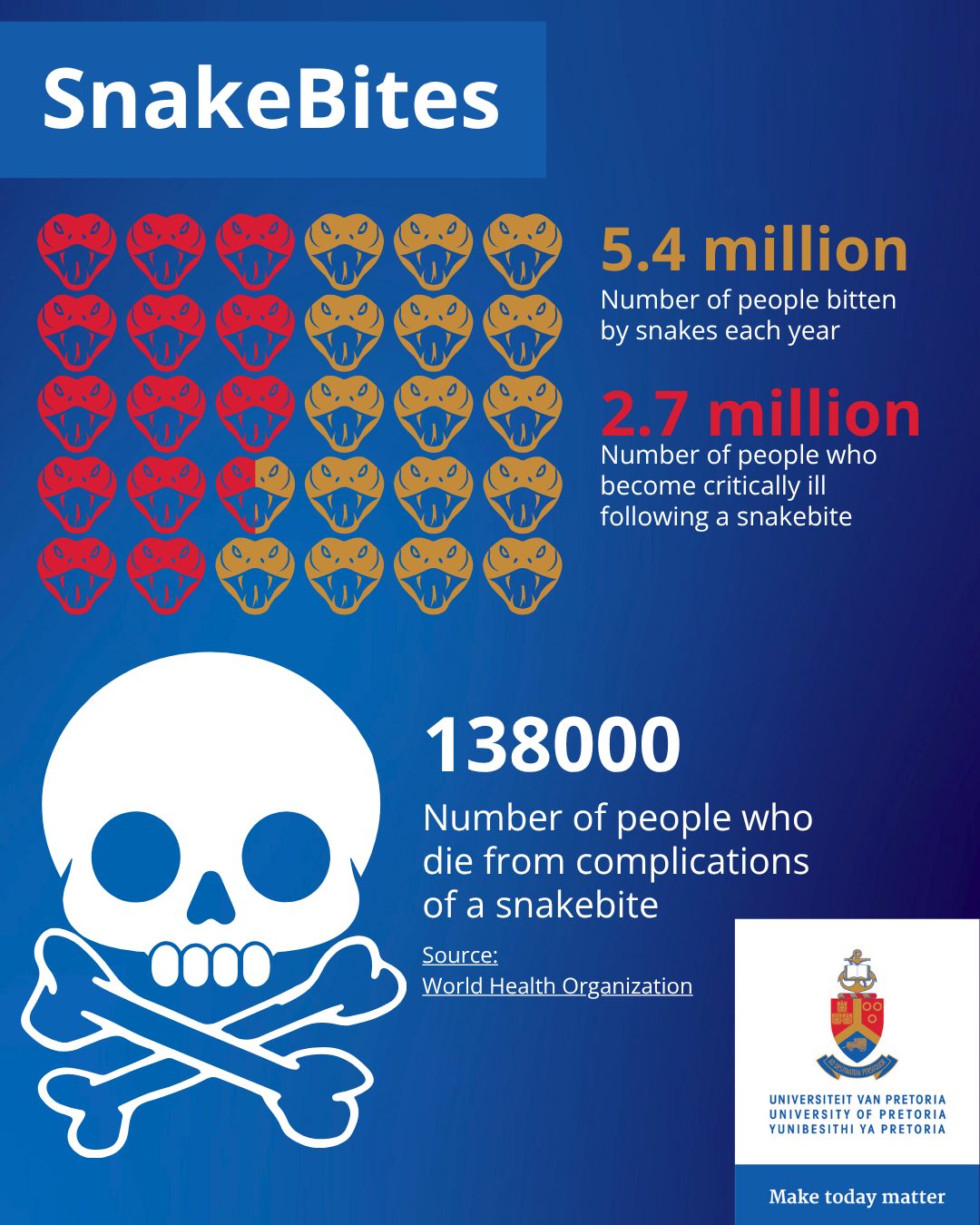
While snakebites remain a neglected public health issue globally, the numbers are sobering. The World Health Organisation estimates that every minute, around 10 people are bitten by snakes worldwide. Every four minutes, someone dies, while many more are left with permanent injuries. Researchers believe the true figures are likely even higher, as many victims never reach medical facilities.
But the impact stretches well beyond human health.
Snakebites also affect pets, livestock, agriculture, conservation and rural livelihoods, with many animal owners unable to access or afford life-saving antivenom. Researchers are now exploring how changing landscapes, farming practices and even climate change may be influencing snake behaviour and increasing encounters with people.
Dr Sara Padidar from the University of Pretoria’s Department of Biochemistry, Genetics and Microbiology has made snakes and snakebites the focus of her research.
“Snakebites should be the poster child for One Health, yet we often focus on the bite and forget about the snake,” she explains.
Her research raises fascinating questions, including whether differences between captive and wild snakes could influence the venom used to produce antivenom, potentially improving treatments in the future.
Related Stories
 Save a Fishie's Zoë Prinsloo Named SA's Only Diana Award Recipient!
 Young Robotics Team Puts Biodiversity on the Map with Conservation Project in Johannesburg
Working alongside the Eswatini Antivenom Foundation, the team is also focusing on something equally important: education.
Rather than encouraging fear, researchers are helping communities better understand the role snakes play in healthy ecosystems and how simple changes can reduce dangerous encounters.
The results have already been encouraging.
“It has been remarkable to see the receptivity and behaviour change among the community towards snakes,” says Dr Lindelwa Mmema, a project manager at the Eswatini Antivenom Foundation.
“Once it was a matter of ‘a good snake is a dead snake’. Now we’re receiving photographs from the public of snakes in their garden that they are affectionately calling ‘farmers’ friends’.”
That shift in thinking matters because snakes are natural pest controllers, helping keep rodent populations in check and supporting healthy ecosystems.
Researchers are also investigating how urban expansion and climate change may alter snake populations and movement patterns.
Professor Ara Monadjem, Head of the University of Pretoria’s Department of Zoology and Entomology, explains that warmer weather is only part of the story.
“We know we see more snakes in spring and summer, and very few in winter, but is it just about temperature and rainfall?” he says. As prey animals become more active during warmer months, snakes naturally follow their food source, increasing the likelihood of encounters with people.
By bringing together experts in ecology, zoology, biochemistry and community education, the University of Pretoria’s research is tackling snakebites from every angle, with one simple goal: saving lives while protecting an important part of Southern Africa’s natural heritage.
 by