Groundbreaking research is rewriting the science behind giant prehistoric insects and their size limits.
South Africa (31 March 2026) – Hundreds of millions of years ago, Earth belonged to giants of a different kind. Dragonfly-like insects with wingspans stretching up to 70 centimetres patrolled the air, their shadows skimming across swampy forests that blanketed the supercontinent Pangaea. It’s the kind of image that feels almost mythical, the sort of thing you’d expect to live in storybooks rather than science journals.
And for decades, there was a neat explanation for it all. These enormous insects, scientists believed, were only possible because the atmosphere itself was different. Oxygen levels were thought to be dramatically higher, fuelling the energy demands of flight in ways today’s conditions simply couldn’t support. It was one of those theories that settled comfortably into textbooks, repeated often enough to feel like fact.
Until now.
A new study led by researchers at the University of Pretoria (UP) and Adelaide University in Australia overturns the long-standing theory that gigantic dragonfly-like insects could only have existed 300 million years ago because atmospheric oxygen levels were about 45% higher than they are today.
Prof Edward (Ned) Snelling, an experimental physiologist in UP’s Faculty of Veterinary Science who led the study said “our findings suggest a need to reassess textbook explanations of what limits the body size and energy demand of the most diverse and abundant animals on the planet – insects.”
Earth was very different 300 million years ago. The waters teemed with fish, the land was dominated by amphibians and crawling arthropods, and the skies were ruled by flying insects, some of which had massive proportions. There were giant mayfly-like species with 45cm-wide wingspans and enormous dragonfly-like species with wingspans 70cm wide. These were the “griffinflies”, first discovered as fossilised impressions in fine-grained sedimentary rock in Kansas in the US nearly a century ago.

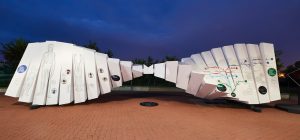
Photo Credit: Estelle Mayhew, adapted from image by Aldrich Hezekiah. Giant petaltail – Photo Credit: Estelle Mayhew
In the 1960s, scientists reasoned that such large flying insects could not exist contemporaneously because lower oxygen levels could not support the high demand for oxygen in the insects’ flight muscles. This made sense, as insects obtain oxygen through their unique tracheal system, a branching tree-like system of airways leading to their ends, the tracheoles. Oxygen moves by diffusion down concentration gradients from the air to the tracheoles and into the flight muscle cells. Therefore, a higher demand for oxygen and larger body sizes ought to require a higher atmospheric oxygen concentration.
In the 1980s, a new technique emerged that allowed geochemists to reconstruct the gas composition of past atmospheres. Their finding was that a period of high atmospheric oxygen occurred 300 million years ago, coinciding almost perfectly with the appearance of gigantic insects in the fossil record. This correlation reinforced the theory that the body size of today’s insects is constrained by oxygen supply and that gigantism would be impossible in our present-day atmosphere.
However, new research involving an international team from UP, Adelaide University, Trinity College Dublin, Arizona State University, Stellenbosch University, University of Greifswald, University of the Witwatersrand and University of Auckland, and published in Nature, has challenged the theory.
Related Stories
 AWS Therapy Dogs Bring Comfort and Connection This Alzheimer’s Month
 Two Adorable Little Fox Pups Rescued Near Vryheid!
So, How Did They Do It?
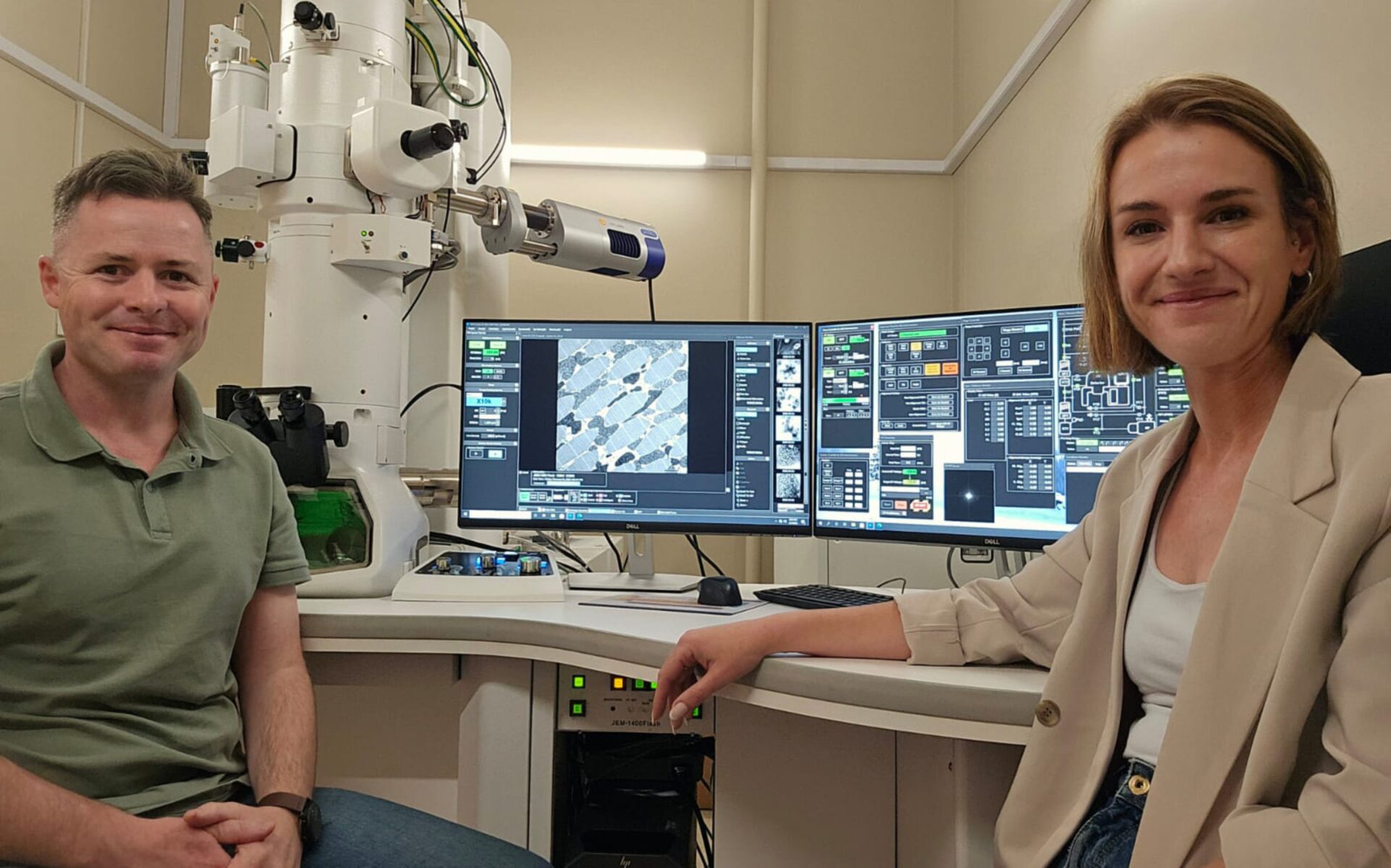
Using high-resolution electron microscopy, the research team determined how the diffusion-dependent tracheoles supplied oxygen to flight muscle cells in insects of different body sizes. They found that the space occupied by tracheoles in the flight muscle is typically only 1% or less in most species, and that this observation holds when the relationship is extended to 300-million-year-old griffinflies. This indicates that flying insects are not constrained by atmospheric oxygen levels; they could easily compensate for different levels of atmospheric oxygen by adjusting the number of tracheoles in the muscle, as they take up so little space.
“If atmospheric oxygen really sets a limit on the maximum body size of insects, then there ought to be evidence of compensation at the level of the tracheoles,” says Prof Snelling. “There’s some compensation occurring in larger insects, but it’s trivial in the grand scheme of things.”
Dr Roger Seymour of Adelaide University adds,
“Capillaries in the cardiac muscle of birds and mammals occupy about 10 times the relative space that tracheoles occupy in the flight muscle of insects, so there must be great evolutionary potential to ramp up investment of tracheoles if oxygen transport were really limiting body size.”
Although some scientists argue that oxygen flow upstream of the tracheoles could still, in theory, limit body size, Prof Snelling believes that “any such challenge upstream of the tracheoles could be adequately compensated for by increasing tracheolar investment downstream”.
The research utilised high-resolution electron microscopy to image the flight muscle.

that supply oxygen directly to the cells. Photo Credit: Antoinette Lensink
“The insect material was technically challenging to work with,” said Dr Antoinette Lensink of UP’s Faculty of Veterinary Science and manager of the Faculty’s Electron Microscope Unit, adding that “it was very rewarding to uncover fundamental biological insights that challenge long-held assumptions about insect body size”.
Prof Chris Weldon and Dr Christian Deschodt of UP’s Department of Zoology and Entomology were also involved in the project, which took more than five years to complete.
“It’s exciting to finally share these findings, drawn from Africa’s remarkable insect diversity, in a high-profile journal such as Nature,” Dr Weldon says.
More than five years in the making, the study doesn’t just answer a question. It opens several more. And that’s usually how you know something meaningful has happened.
Somewhere between those ancient skies and modern microscopes, the story has shifted. What we thought we understood about the limits of life, even in its smallest forms, is being rewritten.
And it leaves us with a world that feels a little less predictable, a little more curious… and far more interesting than we imagined.

300 million years ago. Photo Credit: Jovan Snelling.
 by
by